


Low-carbon design accounts for two sources of emissions: the embodied carbon associated with Â鶹´«Ã½Ó³» materials and the operational carbon produced as a building consumes energy.
Both matter, but they do not always capture the carbon generated when a building envelope fails earlier than anticipated.
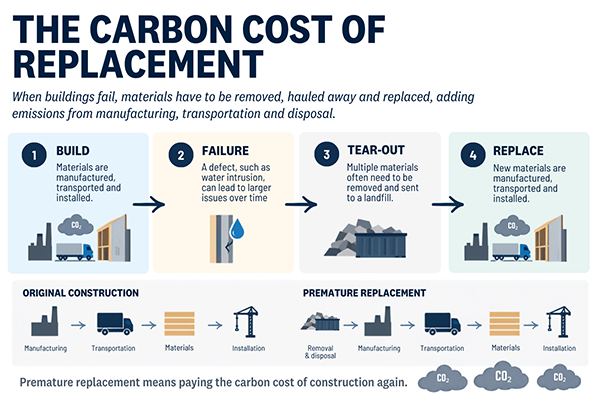
Premature failure can trigger a cycle of investigation, demolition, manufacturing, transportation and Â鶹´«Ã½Ó³». It can cause a building to consume more energy while the underlying problem remains unresolved. What begins as a localized performance issue can therefore become a source of unplanned carbon over the life of the building.
The carbon that follows failure
Embodied-carbon calculations generally evaluate the materials required to construct a building, along with replacements expected during its anticipated service life.
That assessment partly depends on the building and its components performing for as long as planned. When materials must be removed and replaced ahead of schedule, the building’s actual carbon impact begins to move beyond the original calculation.
The replacement product is part of that impact. New materials must be manufactured, packaged and transported to the project, while contractors and equipment must return to complete the work. Removed materials must also be hauled away, processed or disposed of, adding another consequence that may not have been anticipated during design.
Accessing a concealed problem can expand the scope further. Contractors may need to remove finishes, cladding or other functional materials simply to investigate the affected area and reach the source. Materials that performed properly may become waste because they stand between the contractor and the component requiring repair.
Building envelope deficiencies can also increase operational carbon before corrective work begins. Moisture-affected insulation may not provide the thermal resistance anticipated during design, while uncontrolled air leakage can raise heating and cooling demand. Because these conditions are often hidden, the building may operate below expectations for months or years before the cause is identified.
How localized problems become larger repairs
Moisture intrusion, air leakage and condensation rarely remain confined to the precise location where a deficiency begins. Water can travel through materials and assemblies, while air leakage can carry heat and water vapour into spaces where they were never intended to go. Visible evidence may appear some distance from the actual source.
Condensation demonstrates how damage can develop without an obvious exterior leak. Warm, moisture-laden air moving through an unintended opening may reach a cold surface within a wall or roof. Repeated exposure can affect insulation, sheathing, fasteners and finishes before occupants recognize a problem exists.
By the time the source is located, the repair may involve more than sealing one opening or replacing one material. Surrounding components may need to be removed to determine how far the damage has travelled, allow the assembly to dry and restore continuity. A limited deficiency can consequently produce a repair project with a much larger material and carbon footprint.
Why upfront carbon does not tell the whole story
A product with lower upfront embodied carbon may appear to offer the best environmental result. That information is valuable, but it represents the product at the beginning of its service life. It does not establish how the product will perform within the complete building envelope or whether the assembly will remain functional for the period assumed.
If an assembly requires premature or repeated replacement, each intervention brings another round of material production, delivery, removal and Â鶹´«Ã½Ó³».
An initial carbon advantage can become less meaningful if it is followed by additional energy use, waste and replacement activity. Lifecycle comparisons therefore need to account for service life and expected performance, rather than focusing exclusively on carbon at the point of manufacture.
Higher embodied carbon does not automatically make a product more durable or preferable. Carbon values must be evaluated alongside exposure, compatibility, assembly design and anticipated service conditions.
Durability is therefore part of the lifecycle carbon equation. A durable building envelope reduces the likelihood that otherwise functional materials will be removed before their time. It also supports the operational performance on which many whole-building carbon assessments depend.
Reducing the carbon risk
Long-term performance depends on more than the durability of individual products. It also relies on continuity between control layers, co-ordination at interfaces and the ability of the assembly to manage moisture, temperature changes and movement. Even a strong product may fall short if adjoining systems are incompatible or important transitions cannot be constructed reliably.
Project teams can reduce this risk throughout design and Â鶹´«Ã½Ó³». Constructability reviews, trade co-ordination, mock-ups, inspections and field testing can identify problems before work is concealed. Clear installation requirements and contractor training can also help the completed building envelope reflect the intended design.
Repairability deserves attention as well. Buildings require maintenance, and some components will inevitably reach the end of their service lives. Designing assemblies so serviceable elements can be accessed without unnecessarily removing adjacent materials can limit waste and reduce the carbon associated with future work.
Reducing that cost requires more than selecting products with favourable upfront numbers. It requires durable assemblies that are appropriate for their exposure, co-ordinated carefully and constructed as intended. The lowest upfront carbon footprint will not necessarily produce the lowest impact over a building’s life if durability and long-term performance are left out of the equation.
Rockford Boyer is a building science leader at Elastochem Specialty Chemicals and brings over 20 years of technical knowledge in sustainable building design. Send Industry Perspectives Op-Ed comments and column ideas to editor@dailycommercialnews.com.


Recent Comments
comments for this post are closed