


Many factors point to Mass Timber Construction (MTC) as having a promising future. For several years, claims of wood’s environmental superiority over steel and concrete have dominated discussions.
However, MTC has more to offer than claims of significantly lower embodied carbon through carbon sequestration.
Across a variety of projects, MTC can also demonstrate its positive visual impact and versatility.
In fact, Advocacy group ThinkWood reports at the , six of the 10 recognized projects featured wood Â鶹´«Ã½Ó³» and mass timber.
In the , all eight winners featured mass timber, “a strong indication that the material is becoming part of the contemporary education design vernacular.�
One winner was the 650-student in Hempstead, New York. Designed by Martin Hopp Architect, exposed Ìý²¹²Ô»åÌý were key elements for the school’s successful delivery of a daylight-filled, biophilic environment, together with the target of achieving net-zero and a LEED Platinum rating.
The Amy Gutmann Hall, Data Science & AI Building at the University of Pennsylvania’s School of Engineering and Applied Science, designed by Lake Flato Architects, was one of eight winning projects at the 2026
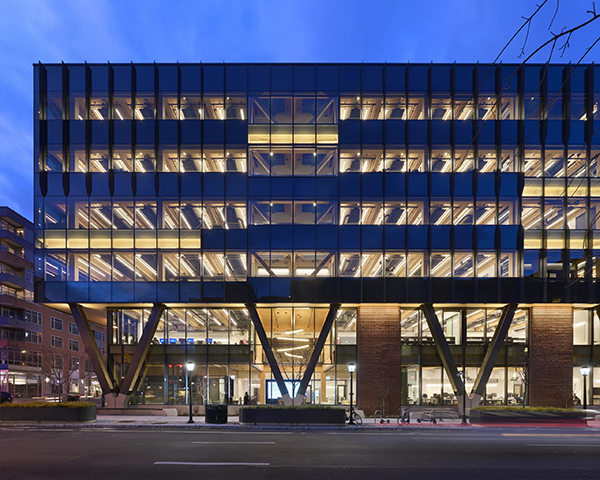
Lake Flato MTC was chosen for the six-storey, 116,000-square-foot building in order to “connect building occupants, who work in a digital realm, back to the natural world — maximizing views and daylight, integrating ecological environments into interior spaces, and incorporating sensory stimuli that encourage collaboration and comfort.�
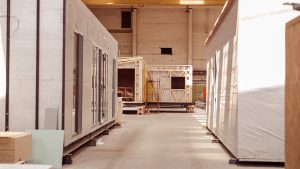
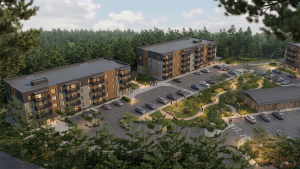
Another of the 2026 award winning projects was the Knight Building, a modular wood affordable housing structure built to accommodate 95 resort employees in Big Sky, Montana.
It is by architects Peter Rose and Partners as “the first large-scale modular mass timber project in the United States.�
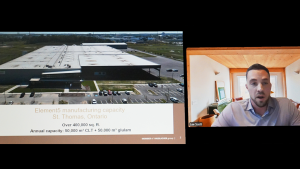
The use of precise mass timber components in a modular process reduced the number of parts by 80 per cent as compared to conventional modular production, decreased labour and Â鶹´«Ã½Ó³» time while delivering exceptional quality.
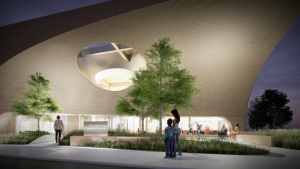
The design possibilities using MTC beams with long dramatic spans were a major influence when it came to the Samuel H. Scripps Theater Center at Hudson Valley Shakespeare (HVS) in Garrison, New York.
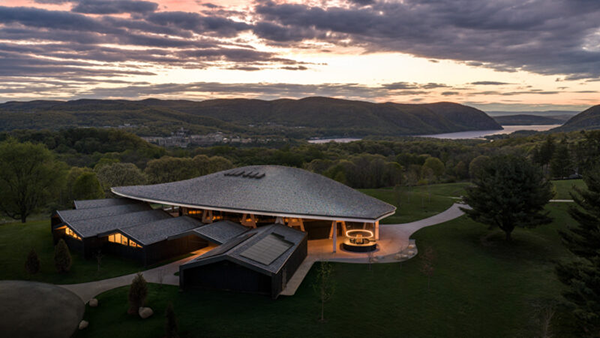
“The gently curved, timber-framed grid shell extends seasonal functionality while evolving HVS’s tradition of immersive, open-air performances, connecting directly to the revitalized landscape and framing views of the highlands along the Hudson River,� project architects Studio Gang.
It describes how the theatre’s new design on a nearby site remains while open to the elements “elevates the overall theatrical experience for both actors and visitors through improved rehearsal, performance and amenity spaces.�
A total 2,833 multi-family, commercial or institutional mass timber projects were in progress or had been built in the United States as of June 2026 to WoodWorks. Numbers have been increasing rapidly with about 1,500 projects currently underway.
In Â鶹´«Ã½Ó³», 700 MTC projects as of 2022, with the Forestry Products Association of Â鶹´«Ã½Ó³» reporting more than 140 projects under Â鶹´«Ã½Ó³» or in the planning stages as of mid-June 2024.
However, some MTC projects can run into trouble. The unfinished 31-storey Edison tower in Milwaukee, once billed by its developer Neutral as “ in Americaâ€� has been the subject of financial problems almost since Â鶹´«Ã½Ó³» began in June 2025.
In late June this year, a default judgment was entered in favour of general contractor , which could result in the sale of the property through a foreclosure process.
The continued popularity of MTC may, in fact, hinge on more than its well-publicized carbon reduction claims. In fact, the core environmental benefits of MTC Â鶹´«Ã½Ó³» are debated by organizations such as the World Resource Institute (WRI).
In its report titled , the WRI finds “using wood to replace concrete and steel could have lower emissions under certain conditions, but they’re challenging to achieve.�
Working against the MTC’s carbon reduction position, the WRI argues harvested lumber loses much of its stored carbon during the manufacturing processes that create MTC components. It also this is compounded by the harvesting and transport of wood through the various stages of production using gas or diesel powered machinery that are rich in carbon emissions.
Hard economic choices must always be made whenever new projects come forward, no matter what materials and processes are under consideration.
For example, in the context of carbon reduction efforts in Â鶹´«Ã½Ó³» such as circularity of materials and carbon-reduced concrete, Aarni Heiskanen the broader problem surrounding green Â鶹´«Ã½Ó³» is that “green values are fine as long as they don’t lead to higher costs, which they currently do.â€�
Yet there is an unexpected benefit for choosing MTC Â鶹´«Ã½Ó³» arising in today’s era of fast-changing economics. For example, North American material costs have increased far more than MTC components in recent years.
In fact, where mass timber supply chain is mature, the over traditional materials has narrowed to as little as 8.0 to 18 per cent according to Q1 2026 data. This is attributed in part to compressed Â鶹´«Ã½Ó³» timelines and savings in builder’s risk insurance premiums.
Politics are also playing a role at the present time. The 50 per cent tariffs on imported Canadian steel and aluminum recently imposed by the Donald Trump administration have pushed those material costs higher.
And although softwood lumber is included at 50 per cent, Glue-Laminated Timber and Cross-Laminated Timber, sub-sectioned under “Builders’ joinery and carpentry of wood,â€� have been left off the so far, leaving them with tariffs of 3.2 per cent plus 33 1/3 per cent.
John Bleasby is a freelance writer. Send comments and Inside Innovation column ideas to editor@dailycommercialnews.com.


Recent Comments
comments for this post are closed