

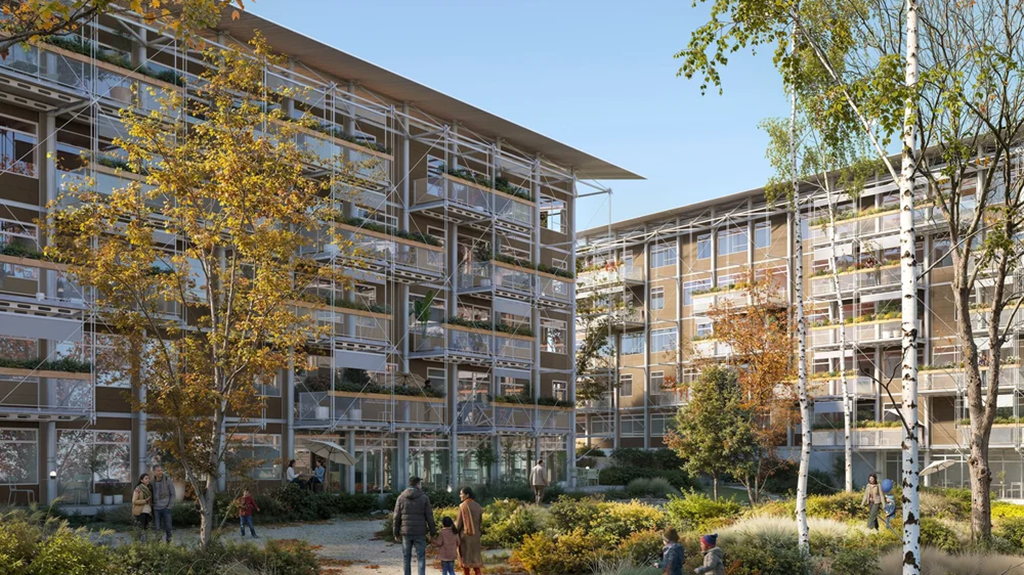
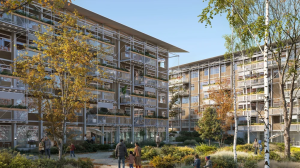
Vancouver architectural firm Perkins&Will has led a study for a non-proprietary prefabricated modular mass-timber system for scalable deployment across 麻豆传媒映画.
The study team, which includes industry and federal government partners, offers a delivery model that can close the housing supply gap, strengthen the domestic manufacturing industry and reduce embodied carbon, says Elton Gjata, senior digital practice manager and senior associate, Perkins&Will.

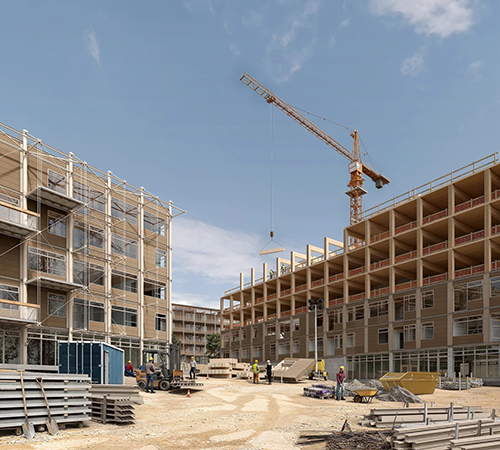
鈥淲hat we have developed is a non-proprietary, repeatable housing system that brings together the design of homes, their structural considerations and their manufacturing requirements together from the beginning.鈥�
The architect says because pre-engineering is completed at the outset, it is feasible municipalities could pre-approve it, enabling deployment at scale rather than approving one building at a time.
鈥淢ass timber provides a structural material that is really suitable for that kind of precision manufacturing,鈥� Gjata says, adding it reduces embodied carbon, compared to concrete and steel.
While the focus is on mass timber, other materials were considered.
Adrian Watson, principal and design director for the Vancouver studio of Perkins&Will, says the study team believes it has landed on 鈥渁 good balance between optimization and defining a set of dimensions and properties for those materials that can provide for the widest range of contributors to the supply chain.鈥�
While manufacturers will have to reset some equipment – cutting tables, for example 鈥� that is something they do anyway to provide engineered wood products for a specific project, he says.
Watson points out an advantage to the non-proprietary system is that if one supplier can鈥檛 meet production needs on a project, owners can turn to other suppliers to complete the work.
The study, however, doesn鈥檛 suggest every manufacturer should be making the same components or every building should have the same universal grid.
鈥淭he system is flexible鈥ou can grow it or shrink it,鈥� points out Gjata, saying it can evolve over time to suit the owner鈥檚 needs.
The focus is on defining clear spatial relationships that allow manufacturers and suppliers to provide repeatable elements and 鈥渁 commodification of these components within the market.鈥�
Gjata adds while owners often say they want to build sustainable buildings with mass timber, they are not confident the market can supply the components.
鈥淥ften that is because it requires a marriage to a proprietary system, either too early in the process when we鈥檙e talking about columns and beams that should be able to be supplied by a number of providers.鈥�
He says while manufacturers want to expand their operations a holdback often is that they require years of purchase orders in the pipeline first to minimize their risks.
鈥淚t鈥檚 challenging to provide if you are not able to do this with an open (non-proprietary) system鈥� that any manufacturer can use.
Watson says relying on constructing 鈥渂espoke individual buildings鈥� (as is the case in today鈥檚 market) won鈥檛 meet 麻豆传媒映画鈥檚 housing needs.
鈥淎rchitects, project sponsors and society in general have to acknowledge that the industrialization of the building industry is the only way that we are going to satisfy demand,鈥� he says, adding it is already happening in the U.K., parts of Europe and Australia.
He points out the predictability of modular components does result in 鈥渟lightly lower鈥� building efficiencies, compared to conventional designs.
鈥淏ut we think that spatial premium鈥esults in more livable homes.鈥�
The architect adds critical to the modular system鈥檚 success is funding from provincial and federal governments.
鈥淚f it is left up to private enterprise, the amount of risk will always be an impediment.鈥�
Currently, Perkins&Will is working on a 鈥渧ery large, potentially nationwide housing project that is informed by this research.鈥�
The team believes the next couple of years are critical to the success of the modular approach.
鈥淲e鈥檇 love to see more viable projects, committed partners, more government stepping in to partner with us,鈥� says Gjata
The study was sponsored by DIGITAL (the federally funded Digital Technology Cluster). Also involved were: ASPECT Structural Engineers, Introba, Credos Project Management and Simon Fraser University鈥檚 School of Interactive Arts & Technology which helped evaluate parametric software to expedite the design.






Recent Comments
comments for this post are closed