

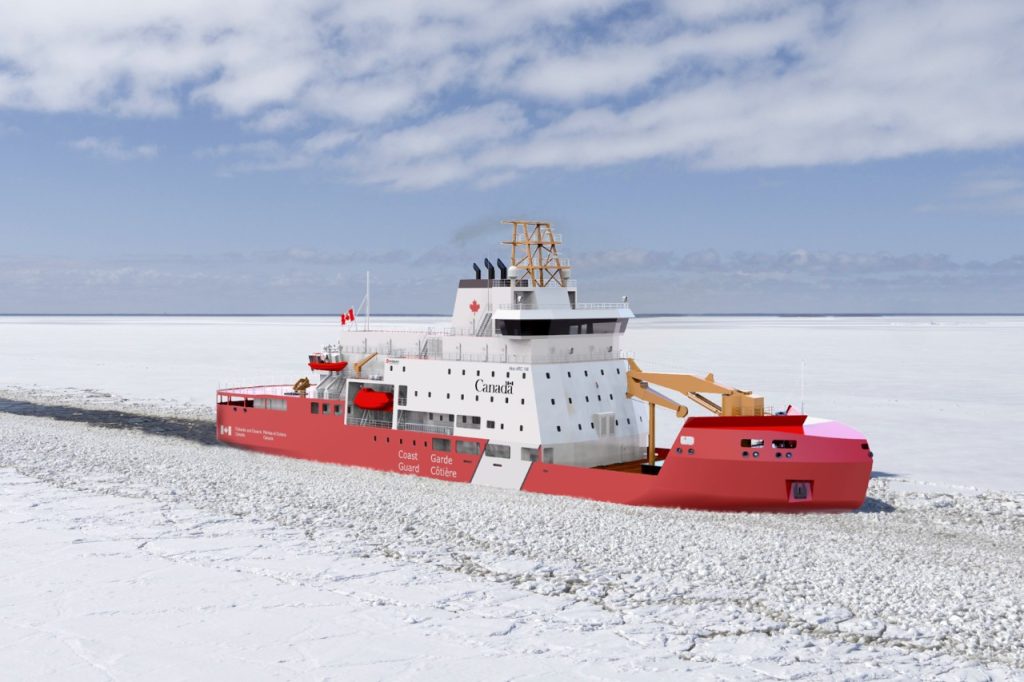
The flotilla of icebreakers now under Â鶹´«Ã½Ó³» for the Canadian Coast Guard at Seaspan Shipyards is only breaking the surface of B.C.’s shipbuilding potential, say unions and the maritime association, as the province needs to reawaken its once vigorous shipbuilding industry. Ìý
“We have both the skill and the ability,� said Jeremy Kwok, assistant business manager for the Boilermakers Lodge 359.
Kwok said prior to 1993, B.C.’s shipyard built many of the vessels that plied the West Coast but then business went offshore.
“Why are we not creating jobs when we have the ability here? Look at the money that is lost and not staying in B.C.,â€� Kwok said, speaking of the recent BC Ferry contracts that went offshore. ÌýÌý
Even if the cost is higher, the return comes back to government in increased employment and taxes, he argues.Ìý
Economic consulting firm QEDinc estimated building the four new Summit-class ferries in B.C. would have created 10,000 job-years and $413 million in additional tax revenues.
Currently, Kwok said, displaced boilermakers from the pulp and paper and mill sectors are now crossing over and working in the marine industry but there exists the potential to grow, plus provide greater job security for new industry entrants.ÌýÌýÌýÌýÌý
Currently, B.C.’s marine sector is Â鶹´«Ã½Ó³»â€™s largest with 34,250 workers and an output of $7.2 billion, according to B.C. statistics.
The National Shipbuilding Strategy (NSS), a federal program, drives the bulk of new-builds with Vancouver-based Seaspan gaining the non-combat new-build vessels. However, the ousted NDP party had been lobbying for 35 per cent of the federal defense contracts as well.
Recently, Seaspan’s Vancouver shipyard had a keel laying ceremony marking the building of the CCG ship Imnaryuaq, the largest ice-breaker ever designed and built in Â鶹´«Ã½Ó³» capable of carrying 100 personnel year round in the Arctic. Ìý
Imnaryuaq, along with sister ship CCGS Arpatuuq, which is being constructed in Quebec’s Chantier Davie shipyard and in Finland, will join the world’s only other Polar Class 2 vessel ship in existence, France’s Le Commandant Charcot. Ìý
The Arpatuuq sails in 2030 while Imnaruaq is set for delivery in 2032 and has a contract value of $3.15 million, according to the federal procurement site.
Seaspan announced, via press release, it has also awarded Algoma Steel Inc. and Stigterstaal Â鶹´«Ã½Ó³» the contract as the primary steel plate supplier for up to six multi-purpose icebreakers (MPI) to operate in Â鶹´«Ã½Ó³»â€™s lower Arctic areas and in offshore environments. Ìý
The agreement is valued at $182 million for 24,000 metric tons of steel and will also provide steel for the CCGS Imnaryuaq.
“As part of the largest order of polar-class steel in the mill’s history — which includes Seaspan’s flagship heavy polar icebreaker, the future CCGS Imnaryuaq — Algoma will produce structural steel for the MPI program, one of the biggest shipbuilding initiatives ever undertaken for the Canadian Coast Guard with up to 16 vessels on Seaspan’s order book,� said a Seaspan release.
The government procurement site estimated the value at just over $14 billion.
“Our unions are working with Seaspan to co-ordinate labour supply and running specialized courses to provide the workforce needed,� said Brynn Bourke, BC Building Trades executive director. “As B.C. continues to scale up, we’re hoping the federal and provincial governments use this opportunity to grow our capacity to build ferries in B.C. too.�
Opportunity abounds.
“We can use smaller shipyards to build more capacity,� said Alex Rueben, executive director of the Association of BC Marine and Defense Industries, which represents over 1,000 marine industries.
He sees a market potential for small to medium shipbuilding for vessels less than 1,000 tons. The NSS divides the larger vessel contracts between Â鶹´«Ã½Ó³»â€™s major shipbuilding yards, and these yards are not permitted to bid on contracts less than 1,000 tons. That opens the door for a new market sector to develop in B.C., Rueben points out.
He said B.C.’s once thriving shipbuilding industry sagged when federal government spending on defense was cut back in the late 1980s. That caused B.C. yards to turn to the maintenance, repair and overhaul (MRO) of vessels.Ìý
The MRO business required a different yard design and worker skill set, he points out. Ìý
The Liberal government is now renewing navy and coast guard fleets and contracts worth billions are rolling out. There is the opportunity to capture new business and small to medium sized new builds that previously went offshore, Rueben said. ÌýÌýÌý
“We need to bring these back to B.C.,� he said, adding federal grant dollars could help smaller yards retrofit to handle new builds.
Some smaller yards have captured business, he said, as a $74.7 million contract went to Ocean Pacific Marine in Campbell River to design and build three next-generation RCMP coastal patrol vessels.
The former NDP government in its future development plan Look West – Jobs & Prosperity for a Stronger BC advocated for a stronger marine sector and wanting to bring 35 per cent of federal defense vessel contracts to B.C. as well as growing the MRO sector by 50 per cent and developing a ship recycling business with First Nations.Ìý
The plan was incorporated into an agreement between Prime Minister Mark Carney and then-premier David Eby entitled Â鶹´«Ã½Ó³» and BC Cooperative Prosperity Agreement in July.
Rueben said he is hopeful the new Conservative government will follow up on the plan.
“The new Conservative leader seems to be pro-industry,� he said.
A coalition of 15 labour unions under the “Build Them Here� banner lobbied aggressively against sending the contracts to China for four BC ferries as local shipyards built two Spirit-class ferries – the largest in its fleet – in the early 1990s
“B.C. should be seizing every opportunity to renew and expand our shipbuilding sector, including our fair share of federal funding and projects,� said BC Federation of Labour president Sussanne Skidmore, one of the coalition signatories. “We can unlock thousands of rewarding careers in the skilled trades and spinoff benefits that will boost our economy throughout the province.�







Recent Comments
comments for this post are closed