

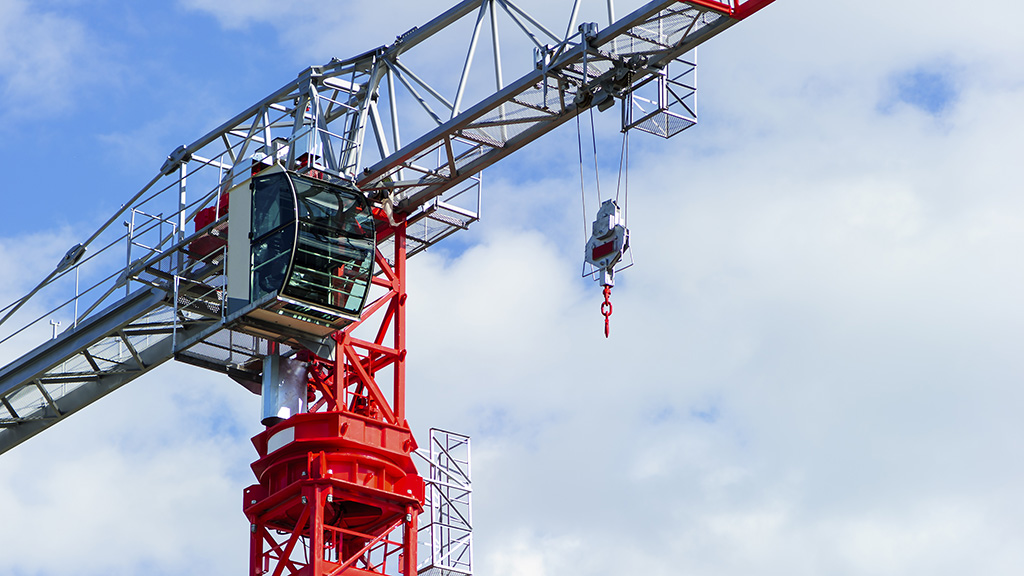
B.C.’s crane industry, under the lens for tower crane incidents, can expect further scrutiny and change by regulatory bodies, according to a newly released September report entitled the B.C. Crane Safety Framework.
The framework sets out recommendations from the 2025 BC Crane Safety Table consisting of representation from B.C.’s Ministry of Labour and Ministry of Post-Secondary Education and Future Skills, WorkSafeBC, SkilledTradesBC, the BC Association for Crane Safety (BC Crane Safety), Technical Safety BC, the Council of Construction Associations, the BC Construction Association, the International Union of Operating Engineers (IUOE) Local 115, BC Building Trades, the International Association of Bridge, Structural, Ornamental and Reinforcing, Iron Workers Local 97 and the BC Federation of Labour.
“I think it is pretty broad and the language is for all cranes,� said IUOE’s Cameron Garrison, whose union has formatted the curriculum for B.C.’s only technical training program for tower and mobile cranes transitioning into an apprentice-journeyman system.
The program is open to union and non-union operators.
“All cranes are considered high-risk,� Garrison said of the 11 different designations of cranes deployed in B.C.
The first recommendation emphasizes a continued focus on all lifting equipment and rigging operations in B.C. with attention to qualifications and competency requirements for operators, supervisors, contractors, rigging and lifting operators and those involved in assembly, climbing repositioning and dismantling erected cranes.
A framework recommendation would see all prime contractors working with cranes licensed by WorkSafeBC. For all high-risk activities involving lifts and crane assembly and disassembly, a WorkSafeBC permit would also be required.
A recommendation already in play is turning tower crane and mobile crane operation into compulsory trades under SkilledTradesBC. By July 5, 2027, all mobile and tower crane operators must be a registered apprentice, a trade qualifier or a certified journeyperson. Until the transition, operators of mobile and tower cranes must obtain a provisional operating certificate from BC Crane Safety or obtain a full scope certification.
SkilledTradesBC offers training in five crane classifications, including the two new Red Seal mobile and tower crane operator categories. BC Crane Safety offers certifications in the six other crane classifications.
Tower cranes have been under focus for some years with seven fatalities that have occurred. WorkSafeBC has reported it has reduced the presence of provisional operators on sites by 50 per cent since 2024 because of insufficient supervision and competency levels.
Angélique Prince, WorkSafeBC’s director of prevention programs and services, said provisional operators have not been the cause of the fatalities, but rather the incidents have brought renewed focus onto sites and the need to make the two areas of crane operation change to Red Seal designations.
“We continue to focus on site co-ordination, who are the people directing on the ground, rigging workers and crane information.�
The influx of provisional workers is attributed to retiring operators and increased building demand.
BC Crane Safety annual reports show all provisional tickets consistently outnumber full-scope certification.
In 2020, BC Crane Safety issued, in all crane categories, 642 provision certificates and 379 full scope certificates. By 2023, that figure nearly tripled with 1,673 provisional certificates and 544 full scope certificates.
Since then, the figure has been dropping with 2024 seeing 1,503 provisional certificates and 614 full scope and in 2025, 1,246 provisional certificates an 700 full scope. BC Crane Safety did not respond to a request for an interview regarding the figures.
As of January 2026, WorkSafeBC quoted in the framework report the number of provisional operators on tower cranes now stands at 169 with 395 full-scope certifications and on self-erecting cranes 20 provisional operators to 644 full-scope.
Provisional tickets have been open to abuse, industry acknowledges.
Provisional ticket holders can renew once or three times (depending on the crane) for a two-to-four-year life.
Ralf Notheis, manager at Bigfoot Crane Academy, said the individuals running provisional tickets beyond their life are usually tower operators who have failed the theory test to move to the next level or those reluctant to do the classroom work.
His company, he said, has and is working with these individuals to help them move forward in the transition period demonstrating how theory links to the practical.
“We tell them why they need to know it and why they are doing something,� he said.
He’s also preparing for the future and is hoping to assemble a training program similar to that offered by the IUOE.
Supervision is known to be an issue as well. Notheis said he has heard of supervisors having as many as 35 provisional operators to watch on multiple sites.
Mark Walker of Fraser Valley Crane Training agrees workforce changes in the past few years have accentuated the problems.
“They put people in who were not trained and WorkSafeBC is now playing catch-up.�
Under the new SkilledTradesBC regulations for mobile and tower operators, the ratio is now two apprentices to one journeyman.
B.C. leads Â鶹´«Ã½Ó³» in tower crane use. The five-year high in 2024 saw 409 cranes in use, decreasing to 373 cranes today while Toronto has only 106 active tower cranes.
Notheis said in B.C. it has now become less costly to rent out cranes at lower rates than pay for storage.
Another concern is vintage. Garrison said there are no limits on the life of tower cranes used – only New York imposes a 25-year life. Looking out the window of his office, he said “there are cranes older than me� citing a 1975 built crane.
Garrison said he is now part of an industry group that is attempting to put together the criteria for rigging certification that pertains to industry cranes.
The current regulations are broad and encompass all facets of lifting and rigging including even patients in hospital, he said.
“What are 100 things that a rigger should know?� he said, adding once that has been determined, a training model with certification can be implemented.
The framework report can be







Recent Comments
comments for this post are closed