

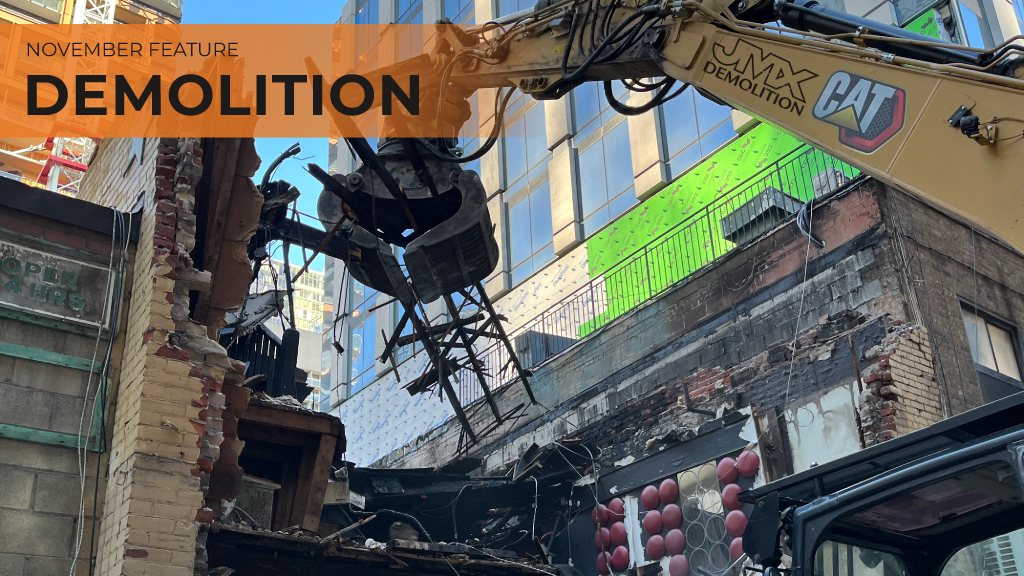
A Cat 325 zero tail swing excavator with a rotating grapple has been the workhorse in the preservation of a well-known building in downtown Toronto.
Located on Yonge Street, the Zanzibar Tavern has been an adult entertainment nightclub and local landmark since it opened in 1960 — although the building it’s located in was built in about 1896 and other businesses previously operated there.
A surgical partial demolition and remediation by Uxbridge, Ont.-based JMX Contracting Inc. will ensure it continues to be a landmark following a three-alarm fire last August. The fire gutted the interior and caused the roof on the eastern or rear portion to collapse.
“Sixty per cent of the building is still intact and the goal is to make the building safe while preserving as much as possible for rebuilding,� says JMX president Charlie Dahl.
Following the fire, Dahl and tavern owner Allen Cooper met to plan a strategy for preserving the building. Saving the Zanzibar means preserving both the building and a family business which has been part of Yonge Street for more than six decades.
Cooper’s father, David, purchased the Zanzibar in 1960, says Dahl.
“I met with him (Cooper), walked through the building with him and promised that JMX would approach the debris removal carefully, with the future of both the building and the family business in mind.�
An assessment by T. Smith Engineering recommended a systematic removal of damaged framing and unstable masonry, removal or temporary shoring of a deflected interior false wall and subsequent removal of water-damaged finishes and contents.
And that process JMX followed during a two-week schedule in October.
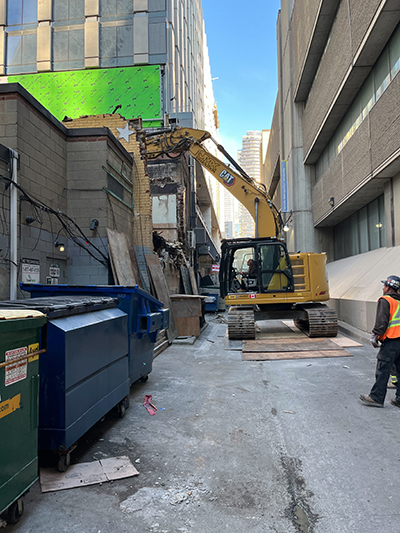
Access to the eastern portion of the building where the fire caused the most damage was through a very tight rear laneway surrounded by other Â鶹´«Ã½Ó³» including the Â鶹´«Ã½Ó³» of a large condominium just north of the tavern.
“That (the condominium Â鶹´«Ã½Ó³») added to the complexity of the project.â€�
Conventional demolition methods on the damaged building would almost certainly have destroyed the subfloor and further compromised the north and south walls and would have meant the tavern couldn’t be saved, he says.
“Preserving those elements required careful removal of the material resting within the building.�
That’s where the Cat 325 zero tail swing excavator comes in.
After the contractor obtained a City of Toronto permit to close the busy laneway for a Friday, Saturday and Sunday, the demolition proceeded with the operator “reaching� within the first 45 feet of the building.
“We used it (the machine) to demolish the damaged material using cables and rigging for portions beyond the excavator’s reach. Throughout the work, we were very careful not to disturb the north and south walls.�
Some sections, including stairs and platforms, had to be carefully rigged, lifted and removed. Experienced demolition workers attached the rigging while working from the basket of a 45-foot articulating man lift, positioned above the material, says Dahl.
Approximately six 40-cubic-yard bins of debris were removed and placed into dumpsters. They were removed when full and replaced throughout the day, he says.
The contractor and the owner are conducting planning and engineering for the next phase. This will involve removing interior building finishes, including finishes affected by mould stemming from water used during firefighting operations.
This work is planned to continue in December. Some shoring is required and JMX will undertake that work.






Recent Comments
comments for this post are closed