

For decades, R-value has been the primary measure of insulation performance. It appears in building codes, specifications, energy models and product literature, providing a common benchmark for comparing insulation products.
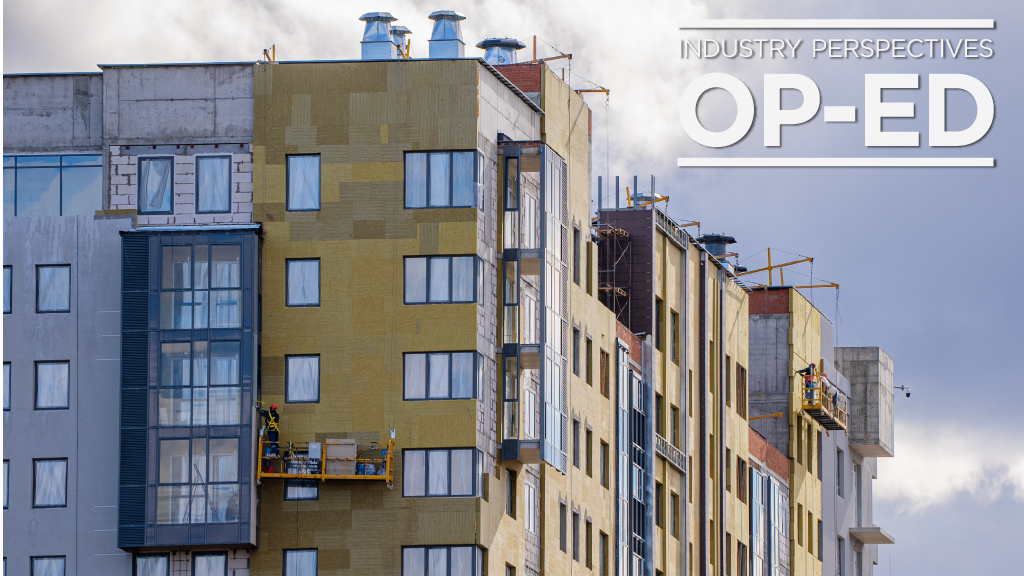
But building enclosures are more than insulation. Framing, sheathing, air barriers, fasteners, windows, doors and installation quality all affect how a wall performs once exposed to weather, pressure differences and temperature fluctuations. As a result, two wall assemblies with identical insulation values can deliver very different levels of energy efficiency, comfort and durability.
This reality is driving growing interest in evaluating complete wall assemblies rather than focusing solely on individual materials.
The shift toward assembly-based performance
The building science community is increasingly emphasizing how assemblies perform in real-world conditions.
One example is the Assembly Performance Value (A-Value), a metric currently being developed by the Spray Polyurethane Foam Alliance (SPFA). Rather than replacing R-value, A-Value is intended to supplement it by considering both thermal resistance and air leakage within a complete wall assembly.
The concept reflects a broader industry shift toward evaluating the entire enclosure system and how its components work together.
Why R-Value tells only part of the story
R-value remains an essential metric because it measures resistance to conductive heat flow under controlled conditions.
However, heat moves through buildings in several ways, including conduction, convection and radiation. Air movement can also have a significant impact on energy performance by allowing conditioned air to escape and unconditioned air to enter.
Because R-value measures only one aspect of performance, assemblies with identical insulation values can perform very differently once constructed. Factors such as air leakage, thermal bridging and installation quality often have a significant influence on actual results.
Air leakage and thermal bridging
As energy codes become more stringent, airtightness is playing a larger role in building performance.
Air leakage can increase heating and cooling loads, reduce occupant comfort and contribute to moisture-related concerns. Even a highly insulated wall may underperform if gaps and transitions allow uncontrolled air movement.
Thermal bridging presents another challenge. Heat can bypass insulation through framing members, fasteners, structural components and other materials with lower thermal resistance. These pathways can significantly reduce the effective performance of a wall assembly compared with its nominal insulation value.
Together, air leakage and thermal bridging help explain why real-world performance often differs from theoretical calculations based solely on insulation ratings.
Where spray foam fits into the conversation
The discussion surrounding assembly performance naturally draws attention to spray polyurethane foam because of its ability to contribute to both thermal insulation and air control when installed at appropriate tested thicknesses.
In many wall assemblies, spray foam can help establish the thermal-control layer while also serving as part of the air-control strategy. Those dual characteristics align closely with the performance factors A-Value is designed to evaluate.
That does not mean spray foam automatically guarantees superior assembly performance. Like any enclosure system, successful outcomes depend on proper design, detailing and installation. Gaps, inadequate sealing and poor workmanship can compromise performance regardless of the insulation selected.
However, the conversation highlights an important consideration for designers and specifiers. When insulation products are compared strictly on published R-values, the benefits associated with air-sealing performance may not always be fully reflected. Evaluating the assembly as a whole can provide a more complete understanding of how different enclosure strategies perform under operating conditions.
Research supports a whole-wall approach
Research conducted by and other building science organizations has reinforced the importance of evaluating complete wall assemblies rather than individual materials.
Studies examining thermal performance and air leakage have shown increased air movement can reduce the effective thermal performance of a wall, even when insulation levels remain unchanged.
The findings also demonstrate that no single insulation product automatically guarantees superior results. Assembly design, detailing, air sealing, moisture control and installation quality all play important roles in determining performance.
What this means for designers and specifiers
Whether A-Value ultimately becomes a widely adopted metric or simply influences future thinking, the broader message is already resonating across the industry.
For architects, engineers and specifiers, wall performance is increasingly being viewed through the lens of the complete assembly. Air leakage, thermal bridging, moisture management, continuity of control layers and Â鶹´«Ã½Ó³» quality all influence how a building enclosure performs over time.
R-value will remain an essential design tool, but it represents only one part of the performance picture. As building science continues to evolve, the focus is shifting toward designing wall assemblies that effectively manage heat, air and moisture while delivering long-term energy efficiency, durability and occupant comfort.
is a building science leader at Elastochem Specialty Chemicals. Send Industry Perspectives Op-Ed comments and columns ideas to editor@dailycommercialnews.com.





Recent Comments
comments for this post are closed