

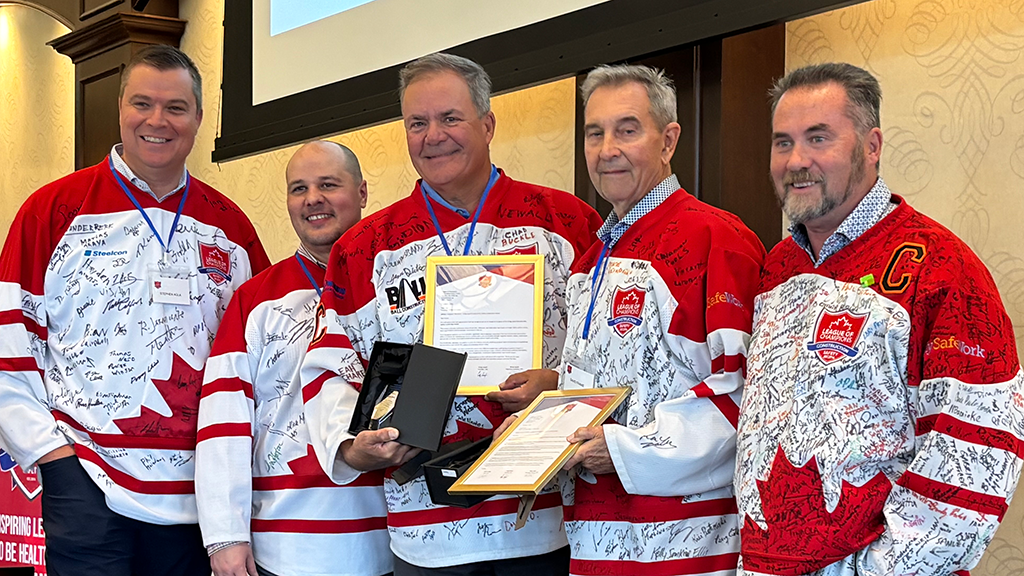
For years, the League of Champions (LOC) has been known for its fierce commitment to physical safety and recently it decided to expand its focus and apply that same level of commitment to worker mental health and wellbeing.
“We’re doing everything we can to keep people safe, but we really have to focus on the mind of the individual,� said incoming chair Jeff MacIntyre at the LOC’s Annual General Meeting, which was held at Eagle’s Nest Golf Club in Vaughan.
“We want to expand our focus into mental health and focus on the person underneath the PPE. We’ve done a good job on the physical. We want to see that same rigour and knowledge applied to the mental side, the human side of Â鶹´«Ã½Ó³».â€�
MacIntyre is also executive director of the Grand Valley Construction Association. In his new role as chair of the LOC, his priority is to continue the momentum that has been created and to make the organization bigger and better.
“It’s continued to grow. It’s continued to gain traction and we want to continue the momentum by familiarizing people with the impact that it has made on the industry from a safety and incidents perspective,� said MacIntyre.
Stephen Agla, outgoing LOC chair and health and safety director at Steelcon, said he is proud of what the organization and the industry accomplished over the past year.
“What truly makes the League of Champions special isn’t just the events, the partnerships we establish or the initiatives; it’s the people,� he said. “It’s the willingness of our members and partners to come together, share experiences, challenge conventional thinking and collectively advance a message that matters deeply to us all: Ensuring every worker goes home safe.
“Together we have the ability to influence meaningful change across the industry. We have the opportunity to challenge the status quo, raise expectations and demonstrate that stronger safety cultures are built through collaboration, leadership and shared commitment to doing what is right,� Agla added.
In delivering the executive director’s report, Brian Leech said in addition to growing the membership to 128 members, the LOC partnered with the Institute for Work and Health and rolled out a safety culture survey in the spring. They also launched a new website last fall, a quarterly newsletter and a virtual roundtable focusing on industry issues. The LOC also continued to build relationships and work with post-secondary trades programs to bring its message and mission to schools while promoting members and the trades as a safe and prosperous career path for students to pursue.
Two new awards were also introduced: the inaugural Craig Lesurf Construction Safety Leadership Award and the Craig Lesurf Construction Safety Ingenuity Award. The awards were named after Lesurf, who is one of the founding members of the league and president of Gillam Group.
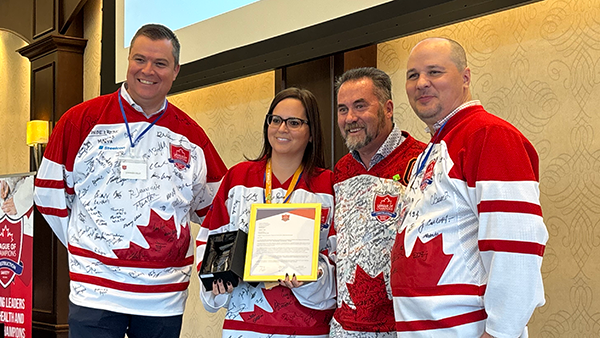
The Construction Safety Leadership Award was presented to three individuals: Clive Thurston, former president of the Ontario General Contractors Association; David Frame, former executive director of the LOC; and Jason Ball, president of Ball Construction.
Frame said he was honoured to receive the award. He said there has been a shift in health and safety in the industry over the past 10 years.
“I entered into this industry 40 years ago and at the time, health and safety was recognized as something you needed to do,� said Frame. “Things have changed over the last 40 years. The culture has improved. Through organizations like the league of Champions, we’re committing to ensuring everyone goes home safely every day.�
Ball, who is also one of the founding members of the LOC and was chair of the OGCA at the time, said the mandate was to share safety programs and practices.
“We wanted to see a cultural change in safety everywhere,� Ball explained. “We may be competitors but we wanted to share safety. One thing that drove me was sharing our safety programs to help other companies get stronger and making a stronger industry from a safety point of view.�
The Construction Safety Ingenuity Award was presented to the Infrastructure Health and Safety Association (IHSA) for its See Something, Say Something campaign.
Deborah Moskal, director of stakeholder and client engagement at IHSA, said it was honour to receive the award.
“It’s a call to action,� Moskal explained. “Speak up if something does not seem right, if you’re unsure, if something seems unsafe. Say something because it can save a life at the end of the day.�
Following the AGM, several safety presentations took place, including Hazards Alone Do Not Cause Incidents, featuring Kevin Brown of Cobalt Safety, a former Ministry of Labour inspector.
“What if I told you hazards aren’t dangerous,� said Brown. “We’ve been focusing on hazards for so long, we’ve got to ask another question: ‘Is it the right thing to be focusing on?’�
The word risk means a choice of action or inaction, he said. He also talked about convenience versus consequence.
“The elephant in the room that we don’t talk about,� said Brown. “It’s humans, human factors. I can’t control what you’re thinking and what you’re doing to do.�
He used the example of jay walking. People do it all the time and don’t get hit by a car so they think it must be safe. After a while, you train your brain to think it’s not dangerous.
“This is what happens on our jobsites,� he said. “We have roofers saying, I’ve been doing this for 20 years, I’ve never fallen off a roof so it must be safe. No, the brain has minimized the danger.�
Construction sites change so fast and the hazards are always changing.
“The best way to solve for human factors is human oversight,� said Brown. “In a dynamic workplace, you need this.�
In her presentation, Beth Kelln, director of strategic development, LivingWorks talked about suicide prevention in the Â鶹´«Ã½Ó³» sector.
Research from Dr. Nancy Carnide from the Institute for Work and Health found Â鶹´«Ã½Ó³» workers die by suicide by a rate of 2.4 times that of the national average and it’s higher than any other sector.
“It’s about talking about what Â鶹´«Ã½Ó³» already does well in physical health and safety and applying those same principles to total worker health and how it impacts positively on operational performance,â€� said Kelln, adding Â鶹´«Ã½Ó³» now has a suicide crisis line, 9-8-8, which anyone can call or text anytime.
She stressed the importance of implementing a network of safety approach.
“It’s designed to fit alongside your existing systems and site processes, not compete with it,� she said. “Like physical safety, mental health and suicide prevention needs to become part of your everyday site culture. It emphasizes shared responsibility and it takes all of us to make it work. It engages all ministries, employers, unions, workers. It’s a peer-to-peer model so that it is truly for the industry, by the industry. You need to make sure it’s available to everyone everywhere regardless of the role that they hold within the organization.�






Recent Comments
comments for this post are closed