

Proponents shepherding the Ontario-Quebec high-speed rail project stressed their team’s extensive international HSR experience and pledged to continue robust consultation efforts during a spirited conference of transit advocates held in Toronto recently.
A keynote morning session at the event Oct. 2 featured representatives of , a crown agency created in 2022, and Cadence, a private consortium comprised of CDPQ Infra, AtkinsRealis, SYSTRA Â鶹´«Ã½Ó³», Keolis Â鶹´«Ã½Ó³», SNCF Voyageurs and Air Â鶹´«Ã½Ó³».
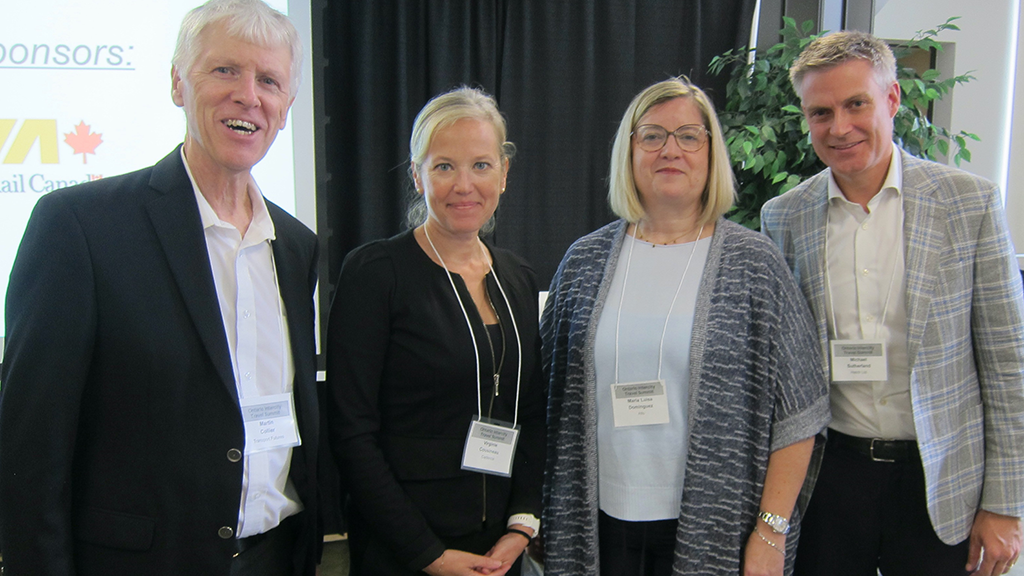
Alto chief project management officer Maria Luisa Dominguez and Cadence senior director of public affairs Virginie Cousineau described Alto as a planned mobility “backboneâ€� for Eastern Â鶹´«Ã½Ó³» between Toronto and Quebec City, co-ordinating with aviation, buses, commuter rail and other modes with the potential to create a significant modal shift.
Major modal shift
Spain’s experience showed HSR shifting Madrid–Seville travel from 60 per cent car, 16 per cent rail, 15 per cent bus and 14 per cent air to 52 per cent rail, 34 per cent car, 8 per cent bus and 4 per cent air within a few years in the 1990s.
“It moved very quickly, just in a couple of years,â€� said Dominguez, who joined Alto after overseeing the expansion of Spain’s HSR network with the Administrador de Infraestructuras Ferroviarias. “Almost 33 per cent of new trips before that didn’t exist because people did not even consider to travel.â€�
Delegates heard approximately 90 per cent of travel in the Toronto–Quebec City corridor is by car. The seven planned HSR stops are Toronto, Peterborough, Ottawa, Montreal, Laval, Trois-Rivieres and Quebec City; Kingston is now under feasibility assessment as a potential additional stop.
The federal government has allotted $3.9 billion so far towards project development and pre-Â鶹´«Ã½Ó³» planning.
Throughout the day Transport Futures presenters and delegates raised a range of concerns related to projected ridership, subsidy requirements, costs and benefits, the effects on farmland, Quebec’s potential opposition, expropriation and escalating projected costs. The day before the conference, a parliamentary budget officer put the estimated Â鶹´«Ã½Ó³» cost of the project at $75 billion to $113 billion, up from the federal government’s current planning estimate of $60 billion to $90 billion.
The conference was billed as an
Martin Collier, the founder of Transport Futures, said his personal view is the HSR project will likely proceed, based on his experience with transportation environmental assessments, with cost as a potential reason for cancellation.
“It’s probably going to happen,â€� he said. “How much does the federal government want to put on the line? Right now, they have a majority, and I think it’s going to end up being politics.â€�
Creating trust
Cousineau, who worked on Montreal’s REM project, stressed trust in the process must be created during the planning stages.
“Building this trust with communities takes time because we are in an approach of change management. ‘There’s going to be this new infrastructure in my neighbourhood,’â€� she said. “‘What is it going to be? What impact will that create on my community?’ So that takes time to build this dialogue.â€�
Procurement and Â鶹´«Ã½Ó³» on the central section, Ottawa to Montreal, will proceed first. The procurement will cover rail infrastructure, stations, tunnels, rolling stock and integrated rail systems.
Cadence issued a Request for Expressions of Interest (RFEOI) for rolling stock on Sept. 18, 2026. Responses are due Jan. 4, 2027.
Alto and Cadence are planning additional RFEOIs this fall (systems) and through 2027 (civil infrastructure, tunnel, stations) for the central segment with RFPs to follow – a “short and tight� procurement schedule, said Dominguez.
Subject to government approvals, Â鶹´«Ã½Ó³» of the Ottawa–Montreal segment is expected to begin around 2029–30, followed by the other segments, with the full network potentially taking about 12 years to complete.
Alto says Â鶹´«Ã½Ó³» on the eastern and western segments will launch simultaneously and work will start before the central segment is completed.
One of the afternoon sessions at the conference featured comments by Chiefs of Ontario Regional Chief Abram Benedict. Cousineau had earlier addressed opportunities for First Nations.
“It’s in every aspect of what we do in the design, in the impact assessment, in the business opportunity, we are considering the Indigenous communities,â€� she said.
“We already know that we need to build the workforce and to prepare and to train the workforce that will be needed for the Â鶹´«Ã½Ó³» and the operation of this project because it’s going to be built by Canadian workers and it’s going to be operated by Canadian workers.â€�
Cousineau said the second wave of consultations will involve “boots on the ground, meeting with communities, understanding their concerns.�
Dominguez noted the final alignment has not yet been determined, and said consultations with potentially affected landowners in November and December will include much more detail than is currently available.
Once the corridor has been determined, the proponents will be more certain of their needs for land.
“Then the acquisition will start, so not until the end of next year…and only for the what we call the early works,� she explained.
During a question-and-answer session the rising estimated costs were raised. Dominguez said as more details are finalized regarding the alignment, the business case will be developed. An announcement on more precise capital costs will be coming from government ministers, she said.

Recent Comments
comments for this post are closed