


Stoneboy is a Toronto-based founded in 2014 by Aditya Arya.
Over that time, it has helped improve the delivery of about 90 projects totalling over $62 billion through the integration of its Â鶹´«Ã½Ó³» management and delivery platform.
From this, they have developed fresh ideas that could improve project delivery for all stakeholders. This month, they reached out to the Ontario government with their in the hopes of developing a new approach to project controls for Â鶹´«Ã½Ó³».
The main issues Stoneboy identifies are project control processes, that being the people, processes, systems and practices that set baselines, track progress, forecast cost and schedule, manage risk and change, and inform decisions. They note the project controls budget is typically buried inside a contractor’s Â鶹´«Ã½Ó³» price as overhead.
Even though public owners depend on them, competitive pressure can encourage only minimally compliant controls. Because the scope and cost of these are not visible, public owners struggle to identify, evaluate, compare and fund them, or judge whether the staffing, systems and methods suit the project’s value, complexity and risk.
“Requiring more frequent or more detailed reports within the same structure may improve the appearance of reporting without necessarily improving the systems, staffing, data, methods, governance, and professional judgment that produce those reports.”
The question is whether the project-specific scope and cost should remain obscured or be clearly identified so the owner can understand what it is purchasing and approve an approach suited to the project.
Stoneboy’s Policy Letter No. 1 proposes Â鶹´«Ã½Ó³» procurement proceeds as before, with bidders competing on the owner’s disclosed criteria such as price, capability, experience and technical compliance but exclude pricing for project controls. During bidding, firms need only confirm they understand and will comply with the disclosed Project Controls Execution Plan (PCEP) process, avoiding the cost of preparing detailed options while competing.
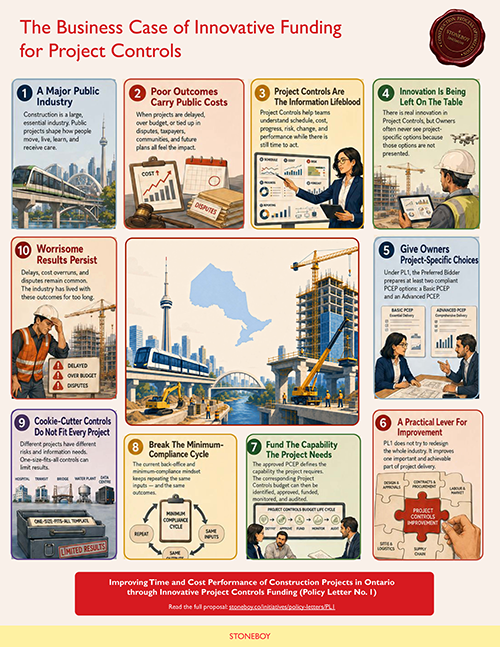
Once the preferred bidder selection is made, project controls would be outlined separately and transparently. The preferred bidder would prepare at least two compliant options: a basic plan meeting all mandatory requirements, and an advanced plan adding project-appropriate capability, plus any owner-requested alternatives, funded through a disclosed capped allowance. The owner would then evaluate the options against pre-disclosed criteria, requiring revisions before approval.
The approved PCEP may combine submitted options, provided all mandatory requirements are met and scope, staffing, systems, data and cost are documented. Its budget, the Project controls budget, would be separately identified, substantiated, monitored and audited.
“This would allow the owner to see the project controls capability it is receiving and its associated cost, while allowing the preferred bidder to develop an approach integrated with its Â鶹´«Ã½Ó³» methods, organization, systems and delivery plan.”
The aim isn’t higher spending, but visible, proportionate, accountable project controls.
The proposal leaves Â鶹´«Ã½Ó³» responsibilities unchanged and priced within the Â鶹´«Ã½Ó³» bid amount. Only project controls items expressly identified in advance qualify for separate funding. There is no hidden second competition and owner review, approval or audit transfers no responsibility.
Following contract execution, the contractor remains responsible for implementing, maintaining and updating the approved PCEP.
Stoneboy explains the proposal is framed as being mutually beneficial.
Public owners would gain visibility into how performance is measured, monitored, forecast and reported — controls proportionate to project value, complexity, duration and risk; clearer governance; reporting, data-access and closeout requirements; earlier warning of cost, schedule, risk and change concerns; more reliable information for forecasting, mitigation and recovery; and stronger auditable records.
Contractors would gain clearer requirements, a fair post-selection opportunity to substantiate appropriate staffing, systems and analytics, and better documentation, forecasting and alignment with their Â鶹´«Ã½Ó³» approach.
“When the owner and contractor begin delivery with a clearly documented PCEP, they are better positioned to work from consistent information, understand emerging issues, and make informed decisions.”
A separately approved project controls budget would also give the preferred bidder room to propose what the project genuinely requires — freedom from the competitive pressure that currently suppresses investment in staffing, systems, training, analytics and technology, and a mandate for much needed innovation in project controls.
Where justified, this could strengthen cost-schedule integration, progress measurement, risk forecasting, change management, automated reporting, dashboards, data analytics and AI.
Technology is not an end in itself. It must serve a defined need, support approved processes and governance, and deliver value proportionate to its cost and complexity.
Stoneboy suggests reform of this type is needed in Ontario today, outlining how Ontario’s public Â鶹´«Ã½Ó³» spans ministries, agencies, municipalities, hospitals, school boards, utilities and transit bodies. All need reliable information while decisions can still change outcomes, not merely after problems emerge.
A stronger project controls framework could improve forecast reliability, reveal risks earlier, strengthen accountability and change management, reduce avoidable surprises, preserve records, sharpen lessons learned and inform future capital planning. Delays, cost increases and disputes will still arise from design, approvals, site conditions, labour, markets, supply chains and governance, but they would be detected sooner and understood better on projects large and small.
Stoneboy recommends the Government of Ontario review their policy proposal and framework and convene a time-limited inter-ministerial and stakeholder working group, drawing on procurement, legal, commercial, technical, Â鶹´«Ã½Ó³», contractor, labour, data, privacy, cybersecurity and project controls expertise.
This group would test the underlying policy and incentive concern, examine legal and implementation implications, consult affected parties, refine applicability thresholds and PCEP tiers, develop procurement, contract, funding, assurance and closeout provisions and recommend an Ontario-appropriate framework with phased implementation options.
A controlled, deliberately scalable pilot of up to 10 public projects is Stoneboy’s preferred evidence-building path, although review and preparatory work could proceed even without immediate pilot authorization.
Construction process optimization means pinpointing a weakness, improving and standardizing the process, applying technology only where genuinely needed, then measuring and refining before scaling.
This proposed reform applies those principles to project controls transparency, approval and funding.
Stoneboy welcomes feedback from all stakeholders. Comments can be shared via the , or via email at services@stoneboy.co.
John Bleasby is a freelance writer. Send comments and Inside Innovation column ideas to editor@dailycommercialnews.com.





Recent Comments
comments for this post are closed