

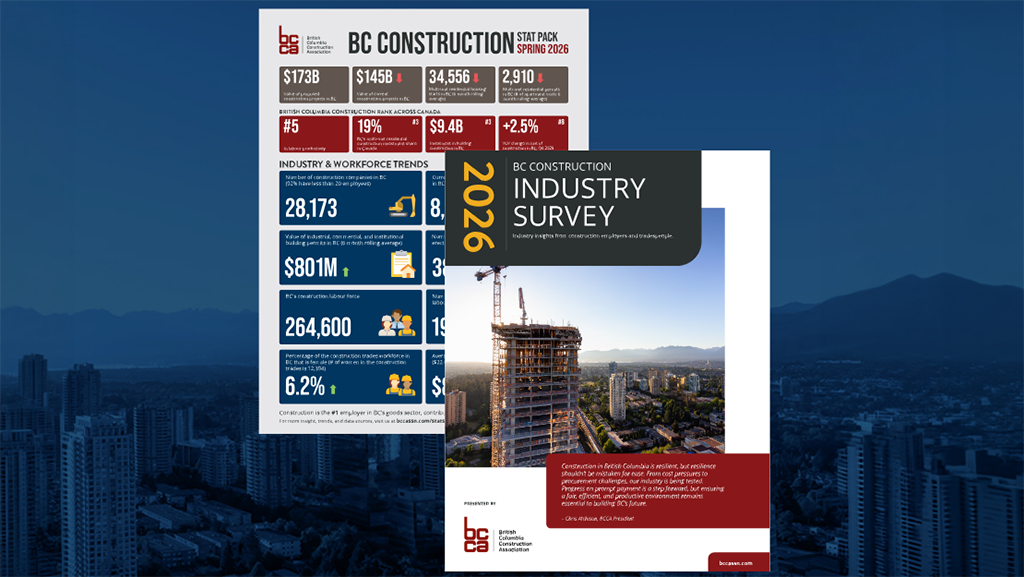
VICTORIA — The British Columbia Construction Association (BCCA) is sharing the perspectives of 858 employers and tradespeople across all of the province’s development regions in its latest industry survey and 2026 Spring Stat Pack, with the results painting a picture of resilience with a call for more government action.
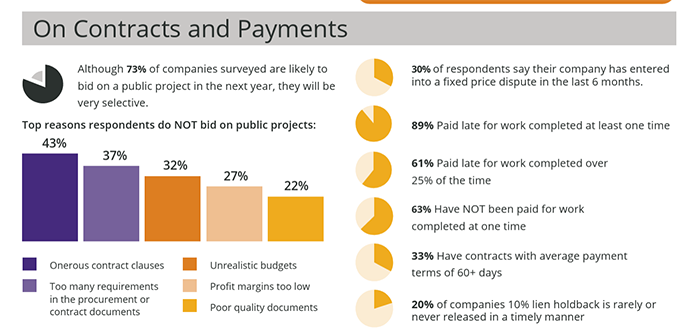
Business owners reported several frustrations, including disputes, non-payment, economic uncertainty and high overhead costs. According to the survey, 89 per cent reported being paid late for work at least one time this past year, while 61 per cent report being paid late for work completed over 25 per cent of the time.
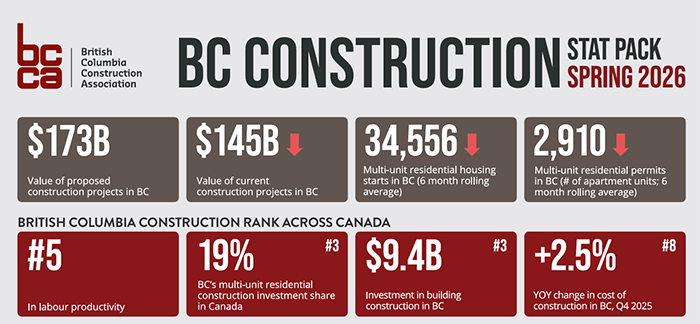
The Stat Pack revealed the estimated value of proposed major Â鶹´«Ã½Ó³» projects in B.C. is holding steady at $173 billion, but the estimated value of current major Â鶹´«Ã½Ó³» projects underway in B.C. is $145 billion, down eight per cent year-over-year.
When asked how much of a risk premium contractors will build into a bid, the average response was 14.5 per cent, with 43 per cent reporting the number one reason they do not bid on a public project to be onerous contract clauses.
Measures like the addition of PST to architectural, engineering and related professional services introduced in Budget 2026 add additional cost pressures that impact project viability and competitiveness locally, nationally and internationally.
“Across British Columbia, our industry is consistently being asked to do more with less,â€� said Chris Atchison, president of BCCA, in a statement. “The industry has shown incredible resilience, especially in light of ongoing economic, global and supply chain instability and uncertainty, but resilience cannot be mistaken for invincibility.â€�
The BCCA is calling on the provincial government, including its agencies, to take concrete steps that will make it easier to build in B.C.
“That means committing to a multi-year capital plan that gives industry the long-term visibility it needs to function; modernizing and committing to fair, open and transparent public procurement; developing a clear federal-provincial strategy to align on large-scale infrastructure; and prioritizing the enactment of the Construction Prompt Payment Act,� the association states.
Until the provincial government addresses these challenges, B.C. risks higher costs while falling critically short on its infrastructure commitments.
“British Columbia depends on builders,” emphasized Atchison. “But high costs, risks and uncertainty have created an environment that makes it harder for our sector to deliver at the level this province requires. With $173 billion in proposed Â鶹´«Ã½Ó³» projects on the books, our province can’t afford to move forward without adequate support for industry.â€�
Here are several other key B.C. Â鶹´«Ã½Ó³» industry stats from the BCCA.
INDUSTRY IMPACTS
- B.C.’s Â鶹´«Ã½Ó³» industry accounts for 9.2 per cent of the province’s total GDP, totalling $28.5 billion.
- Number of Â鶹´«Ã½Ó³» companies: 28,173.
- Value of industrial, commercial, institutional building permits: $801 million – up 15 per cent since the fall 2025 Stat Pack, up 32 per cent since the spring 2025 Stat Pack.
- Multi-unit residential permits (measured as the number of apartment units, on a six-month rolling average): 2,910 – down 24 per cent since fall 2025 Stat Pack, but up two per cent since spring 2025 Stat Pack.
- Multi-unit residential Â鶹´«Ã½Ó³» starts (includes apartment and other unit types, on a six-month rolling average): 34,556 – down 15 per cent since fall 2025 Stat Pack, but only down two per cent since spring 2025 Stat Pack.
- Share of multi-unit residential Â鶹´«Ã½Ó³» investment across Â鶹´«Ã½Ó³» is 19 per cent and ranked number three, which is unchanged.
- Estimated building investment in B.C. for Q3/Q4 2025 was $9.4 billion, ranked number three across Â鶹´«Ã½Ó³» – rank up from number four in fall 2025 Stat Pack.
- Cost of Â鶹´«Ã½Ó³» in B.C. has increased by 2.5 per cent since last year, ranked eighth highest across Â鶹´«Ã½Ó³» – rank down from number four in fall 2025 Stat Pack.
- Number of tower cranes currently erected across B.C. is 380 – up nine per cent.
LABOUR SNAPSHOT
- 264,600 people rely directly on B.C.’s Â鶹´«Ã½Ó³» industry for a paycheque – down one per cent since the fall 2025 Stat Pack; up five per cent since the spring 2025 Stat Pack.
- Number of workers in trades jobs: 199,900 – up five per cent year-over-year (YOY).
- The number of women in Â鶹´«Ã½Ó³» trades is 12,394 (6.2 per cent) – Up from 5.3 per cent in April 2025.
- The average yearly wage of B.C. Â鶹´«Ã½Ó³» employees is $85,488 – up five per cent YOY.
- Current job vacancies in B.C. Â鶹´«Ã½Ó³»: 8,240 – up 13 per cent since the fall 2025 Stat Pack, but down 29 per cent since the spring 2025 Stat Pack.
For more information or to view the and the .







Recent Comments
comments for this post are closed