


Increased adoption of 3D Concrete Printing (3DCP) is a global affair. Projects are becoming taller in height and larger in volume. Here are some of the latest 3DCP achievements.
Housing has been an immediate beneficiary of this growth.
Waco Surf, an inland surf and water park about 100 miles north of Austin, Texas, plans to bring 88 luxury homes, created by well-known 3DCP builder ICON, to its 90-acre Desperado residential community located inside the 450-acre development.
Prices will start at $1.6 million for the mix of freestanding homes and duplexes, all to be anchored by Waco Surf’s numerous water park amenities including a surf lagoon and standing wave pool. Construction is set to begin this year with the first move‑ins expected in 2027.
The homes have been designed by Firmah Architecture and Waco Surf with a specific appearance in mind that suits the 3DCP process.
“We designed The Desperado around this idea of living in flow,” Luke Schock, co-president of Waco Surf. “The architecture, the land, the surf, the trails through the old-growth forest – it all fits together to give you a life where you can move between these completely different experiences in the same day.”
Luxury developments aside, 3DCP is also coming to the attention of municipal jurisdictions as a pathway to the delivery of more affordable large-scale housing solutions within their jurisdictions.
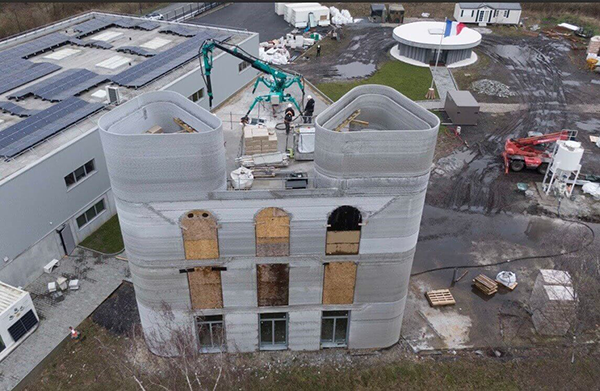
The German-based firm has completed ViliaSprint², a three-storey residential building with 12 social housing units printed onsite in Bezannes, France. Measuring 11 metres wide, 34 metres long, and nine metres high, each floor offers 350 square metres of usable space. PERI 3D says these dimensions make ViliaSprint² the largest 3D-printed apartment building in Europe.
“The project combines numerous aspects of modern, sustainable housing: bio- and geo-based materials, a central heat pump, and a photovoltaic system,� the company . “All loads are transferred directly into the 3D-printed structures – a major milestone for 3D building printing.�
Also noteworthy was the time of Â鶹´«Ã½Ó³», reduced from an originally scheduled 50 days to just 34 active printing days, and a reduction in the assembly crew to only three from the originally intended six.
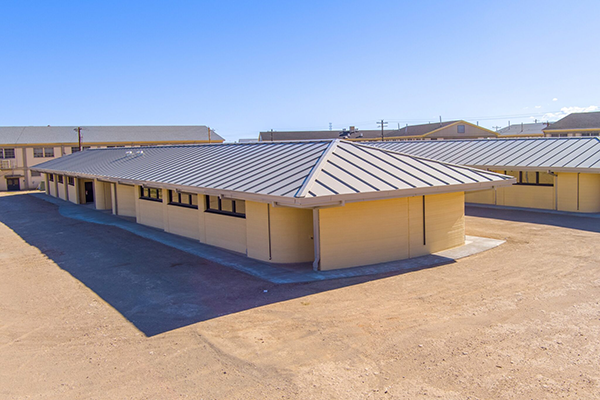
The U.S. Army has now discovered 3DCP. It commissioned ICON to use their 3D robots for the Â鶹´«Ã½Ó³» of to house 560 soldiers at Fort Bliss near El Paso, Texas. The first two buildings opened in July. The remaining buildings were scheduled for completion this month.
The robotic printing of the walls for all 10 buildings was completed in just 58 days. The U.S. Army it achieved a 9.3 per cent cost savings compared to the traditional military Â鶹´«Ã½Ó³» benchmarks set by the Army Corps of Engineers and was completed four times faster than traditional Â鶹´«Ã½Ó³» methods.
In terms of the tallest 3DCP building that can be lived in or occupied by people, the record is currently held by the 14.14 metre high Citadel of Know-How tower in Bruay-sur-l’Escaut, France.
The structure covers 500 square metres over three floors and will house the offices of , the company whose robotic 3DCP printers built the tower. Printing was completed in just 10 days using printing machines developed by Antoine Motte, Constructions 3D’s president. The cement used was an environmentally friendly clay-based cement mixture developed by Sika in collaboration with the R&D team at Constructions 3D and engineering firm Bollinger+Grohmann.
“We are proud of this achievement and thank all the partners, engineers and architects involved in this project,â€� Motte. “The tower by Constructions-3D is not only a symbol of technological innovation but also a testament to collaboration and human ingenuity.”
The engineering evolution surrounding 3DCP continues to press forward and will no doubt expand the potential for buildings much taller than seen today.
The release of called ASCEND developed by Melbourne-based Luyten points the way. Its capabilities, which include AI-powered Â鶹´«Ã½Ó³» automation, will allow the engineering of buildings up to 328 feet tall within a working radius of up to 148 feet.
“The ASCEND Series is redefining vertical Â鶹´«Ã½Ó³» by combining tower crane technology with advanced concrete 3D printing,â€� Luyten says. “Designed for multi-storey buildings, highrise developments and large-scale infrastructure projects, ASCEND enables builders to construct faster, smarter and more efficiently than ever before.â€�
Aarni Heiskanen of AE Partners and a Â鶹´«Ã½Ó³» innovation agent at AEC Business, is a frequent commentator on advances within the industry. He sees certification, standardization and scaling beyond showcase projects as an ongoing challenge facing 3DCP.
“3D printing has moved past the proof-of-concept stage,â€� he .â€� Still, I find it hard to see traditional Â鶹´«Ã½Ó³» firms wholeheartedly adopting it in the near future. In practice, the sector is advancing fastest where there is a clear client need, a repeatable building type and a partner ecosystem that can absorb the technical risk.â€�
There are also logistical challenges, as pointed out in an written by Muhammad Huzaifa Raza, Svetlana Besklubova and .
“Onsite 3DCP faces various challenges in terms of transporting and installing the 3D printer at the Â鶹´«Ã½Ó³» site each time. Large-sized Â鶹´«Ã½Ó³» requires a large printing setup covering the entire Â鶹´«Ã½Ó³» area, and the transportation and installation of such huge setups increase the overall 3DCP cost.â€�
However, 3DCP’s reduced labour requirements, shorter supply lines and inherent high level of automatization suggest the potential for 3DCP to become favourably cost-effective over time compared to traditional Â鶹´«Ã½Ó³» as it evolves further.
John Bleasby is a freelance writer. Send comments and Inside Innovation column ideas to editor@dailycommercialnews.com.




Recent Comments
comments for this post are closed