


Across Â鶹´«Ă˝Ół», a groundswell of new Â鶹´«Ă˝Ół» for long-term care facilities is growing with elder care providers calling it a transformation in health care.
The facilities’ design has been adopted by non-profit care providers and is called small home units, pods or cottage-living.
But, the concept is much the same – a clear shift from large, institutionalized living into smaller contained living units. Many care providers cite COVID-19 as a boosting mechanism.
More than 14,000 seniors and staff – approximately 43 to 50 per cent of COVID deaths – occurred in care facilities, according to Canadian Institute for Health Information.
These small units provide a home-like atmosphere with up to 16 people often participating in cooking, pet care and gardening.
Ontario’s Montgomery Sisam Architects, with a 40-year legacy in designing 80 long-term care facilities, has called the new direction occurring a shift from “a compliance mindset to an innovative mindset in long-term care.”
While the living small model has been used in various levels of care, Montgomery Sisam principal Tony Ross believes it fits best with final stage of life individuals.
“Change becomes more difficult. People are used to having lived a certain way. The transition to a large final institution can be disruptive,” he said. “It (small units) creates a sense of normal.”
These small living units can be built into larger structures but it is the grouping that defines the design, with residents having private rooms with private bathrooms and a centralized kitchen or dining area and family room.
The units are more costly to build and operate, Ross said, adding the square footage allocations per person rises from 650 to 900 square feet and staffing hours increase.
“Although in Ontario, that has risen,” he said, as the threshold of four hours per person of care is being reached.
Up to 40 per cent of clients now ask about the small home model, he said.
Alberta is actively pursuing the model with 398 small care home spaces and is exploring innovative opportunities to expand small group home-style continuing care and supportive living settings, particularly those designed to serve fewer than 10 residents.
“We welcome proposals for additional homes through the Continuing Care Capital Program,” said Jonah Pickle, press secretary for Assisted Living and Social Services.
The next capital program intake to support needs in communities is expected to be this fall.
“Small care home operators are welcome to apply,” he said.
Small homes are also flourishing with Providence Health Care’s program, which aims to “redefine seniors care in B.C.”
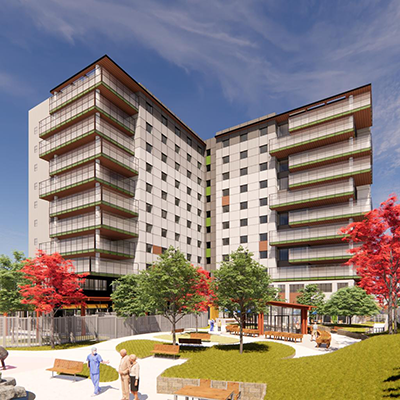
Providence’s St. Vincent’s Heather is set to open in fall 2028 as a 13-storey, 240-bed long-term care facility that will consist of 20 households, each designed to accommodate 12 residents in single-bed rooms with wheelchair-accessible ensuite bathrooms. These households will also feature common spaces, including living rooms, dining rooms and activity areas. Additionally, some suites will have connecting doors to keep couples and families together.
Providence Living started building small-home units in 2024 with the opening of The Views in Comox, a 240-bed LTC facility, which features 13 small households. Other facilities are opening throughout B.C. A facility in Prince George is slated to open in early 2028, Quesnel in late 2028 and Smithers in 2030.
Vancouver Coastal Health has also introduced small units by renovating homes in neighbourhoods branded as small care homes with 10 individuals citing it is less costly to renovate homes than to build large structures.
Manitoba is upgrading its personal care homes.
“Newer personal care homes (PCH) are being designed with greater residential, resident-centred environments, including the small house model,” the Manitoba government said in an email.
Recent projects such as the new Lac du Bonnet and Arborg PCHs incorporate the small house design. Park Manor PCH in Winnipeg will consist of 83 beds, while the Stonewall and district area is also looking to build a small home PCH.
Nova Scotia is seen as a leader in building small homes units for the elderly.
In mid-2025, the Nova Scotia government released a document that provides design guidance for new-build care facilities.
“The document describes evidence-based design concepts that emphasize smaller scale, residential household design features,” the 73-page document said.
Victoria-based Bill Benbow, who retired recently from consulting on senior housing and health care planning, was an early advocate of small homes, beginning in the 1990s in B.C. as dementia patients were a growing concern.
He pioneered new guidelines for care facilities. It led to Heritage Woods, built in 1999, with six interconnecting self-contained cottages. His are still read and used today.
Â鶹´«Ă˝Ół»â€™s Sherbrook Community Centre in Saskatoon is considered a trailblazer as in 1972, it adopted the small house model with homes clustered around community facilities. Founders of the U.S.’s first project, the Green House, opened in 2003, came to view the Sherbrooke prior to opening.
In the Netherlands, De Hogeweyk opened as the first dementia village in 2009, becoming an international model. In 2019 Village Langley opened for dementia patients.
Benbow said using the small homes concept for those with cognitive disabilities was only a starting point.
“Small home units make sense for everybody, and not just those who were experiencing dementia,” he said, adding today’s debate centres on optimum small size for best living experience.
The Canadian Standards Association has published design standards for small homes under its CSA Z8000 (Canadian Health Care Facilities) with provinces integrating standards in building codes.
With patient hours increasing and growing interest, Ross said the challenge lies in lowering Â鶹´«Ă˝Ół» costs for new buildings. Pre-fab has some application but hasn’t bridged the over-all design needs as each development can be unique in medical services required.
“These places are between a residence and hospital,” he said.








Recent Comments
comments for this post are closed