


“The façade is the part of the building that meets the public first, giving our architecture its identity, rhythm and presence,� Sean Mochan of Edmonton-based exterior curtain wall manufacturer GlasCurtain. “In most cases, the façade is what visitors and users will remember long after they’ve forgotten the floorplan, the mechanical room or the structural grid.�
In fact, it is far too simplistic to regard façades as merely the building’s skin.
“A façade still has to carry architectural expression, but it also has to do the somewhat less glamorous but critically important work of building performance,� explains Mochan. “The façade therefore has to limit heat loss, maintain thermal continuity, manage solar gain, resist air and water movement, and support lower operational energy use without creating new problems around condensation, durability or occupant comfort.�
Buildings have largely moved away from brick-and-mortar Â鶹´«Ã½Ó³» where the façade was part of the actual support structure.
Today, steel, concrete and mass timber framing have reduced the loading-bearing requirements placed on façades. This has allowed façades to become increasingly thinner as technology and materials have evolved.
Older buildings of the past with their brick façades also often meant small windows. The amount of daylight entering the interior spaces was therefore limited. However, modern glass façades, also referred to as Integrated Glass Units, are becoming larger. The result is more interior daylight and a reduction in energy costs for lighting.
Project owners and designers are giving façades new and sometimes complex missions. Technology is answering the call with new combinations of glass and framing to deliver the desired performance in terms of protection, energy efficiency and visual impact.
Clear glazing continues to evolve and advance. Innovations such as improved low‑E coatings and photovoltaic (PV) glass are beginning to turn glass assemblies into energy generators. As a result, building façades can help cut a structure’s operating carbon footprint. PV glass also offers added comfort by providing shading, since the embedded solar cells reduce incoming sunlight.
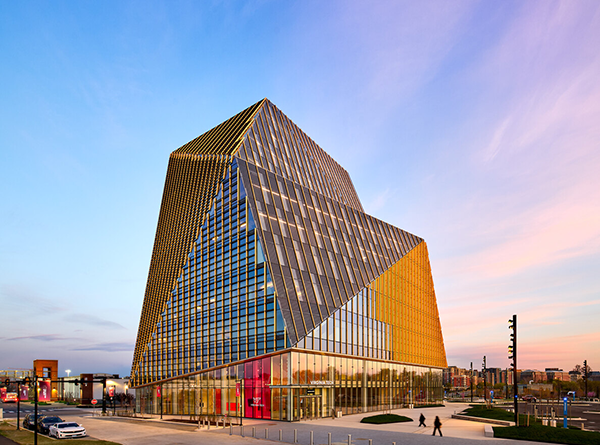
Virginia Tech’s Academic Building One in Alexandria, Va., , is one of the first buildings in the United States to use an integrated photovoltaic glass façade to generate clean solar energy and shade the interior.
Building occupants also love natural light that flows into interior spaces, Dextall, a U.S. manufacturer of modular building exterior components.
“Floor-to-ceiling glass is a marketable feature that commands premium rents in many submarkets.�
Yet for all the benefits that clear glazing brings to a building’s appearance and the enhanced well-being that natural light brings to occupants, there are factors pointing to a reduction in Window-to-Wall Ratios (WWRs) in future projects, despite the architecture’s continued search for dynamic design.
Stricter energy codes, concerns over the thermal efficiency of glass versus opaque walls and interior overheating are leading towards recommended caps on WWRs of 40 per cent or less. Yet there is a design solution, such as using the latest glass technology and orienting the glazed exterior to the north and east while using opaque surfaces on the west and south where solar heat gain is higher.
Rather than threatening a decrease in natural light and architectural beauty, GlasCurtain managing director Peter Dushenski told the Daily Commercial News “right-sized� glazing ratios will be increasingly sought in the future.
“Right-sized glazing ratios will also encourage better architecture. Designers will be required to frame views more intentionally to manage solar heat gain more thoughtfully and to ultimately produce better, more durable and probably even more beautiful buildings.�
Today’s climatic conditions have also seen an increase in extreme-weather events. In response, glass makers have raised their products’ impact tolerances to higher wind load stresses as well as protection against the heat and wind-driven debris created by wildfires.
Addressing the matter of thermal performance, Mochan points out that much depends on the geographical location of the project.
“Buildings designed for one part of the world are mostly ill-suited to another.�
Furthermore, specification challenges confront project owners from the outset. Performance cannot be separated from the materials from which the façade is made.
“Material specifications shape the building’s carbon impact and lifecycle impacts, both for building owners and the shared resource environment more broadly,� she continues. “A curtain wall system that reduces operational energy but carries a higher upfront carbon burden, short service life, or recurring maintenance demands has not solved the whole problem. It has just moved the problem into another column.�
Mochan adds while conventional aluminum has been the industry standard for curtain wall framing because of its strength and familiarity, there are critical drawbacks. In cold climate areas like Â鶹´«Ã½Ó³» and the northern areas of the United States and Europe, aluminium’s high level thermal conductivity allows outside cold to move readily through the frame unit thereby reducing the overall energy performance of the façade unit.
This explains why GlasCurtain uses fibreglass framing for the company’s line of products. Since the main reinforcing component of fibreglass is glass, the material behaves much more like the insulated glass unit it supports.
Therefore, it delivers much lower thermal conductivity that in turn reduces temperature transfer at the frame, maintains warmer interior surface temperatures and reduces condensation risk at the frame and edge-of-glass.
“Overall system U-value gives a clearer picture of façade performance than centre-of-glass performance alone.�
Even though his company is a leading manufacturer of thermally efficient glass façades, Dushenski is realistic about the overuse of clear gazing.
“Designing a Miesian glass box just isn’t sensible for our 21st century environment. Yet glazing isn’t going anywhere. It’s just going to get smarter, more discerning and more ‘right-sized’ over time.â€�
John Bleasby is a freelance writer. Send comments and Climate and Construction column ideas to editor@dailycommercialnews.com.


Recent Comments
comments for this post are closed