


Top executives with Kiewit, WSP and Metrolinx working on Toronto’s complex Union Station Enhancement Project took a deep dive into the inner workings of Â鶹´«Ã½Ó³»â€™s first experiment with the alliance contracting model during a recent Toronto Â鶹´«Ã½Ó³» conference.
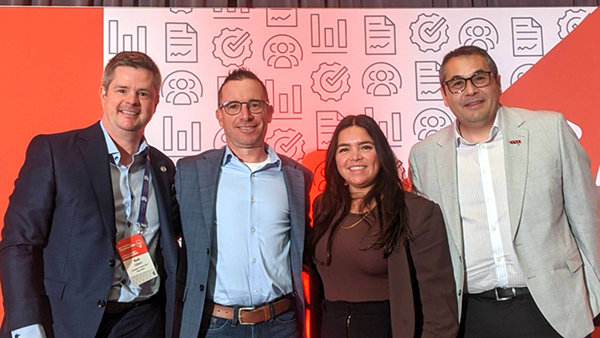
Addressing an Oct. 6 session at the two-day Best Practices in Construction Symposium presented by the Canadian Construction Association, the managers revealed that behavioural coaches were brought in from overseas to help the partners reach consensus on sticky issues – and have stayed on the job five years – and how the partners were able to develop important project requirements on the fly.
The process has never been seen in Â鶹´«Ã½Ó³», suggested Metrolinx executive vice-president of GO expansion, Union-plus, Marcia Medrano.
“The alliance contract is probably one of the simplest contracts I’ve ever read because it’s telling you you have to find a way to work together, and here’s the basic principles. So the human behavioural aspect is huge,â€� she said.
“Everyone’s calories are burned at solving the problem, not at calculating each other’s risk. The hours are being spent with the people that are actually solving problems.â€�
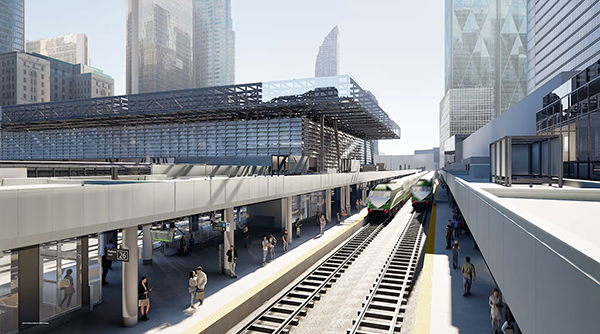
The ongoing improvement project (USEP) at Union Station will deliver an expanded transit hub with new platforms and rail, and help launch multiple GO corridor enhancements, leading to electrification of the regional system. It kicked off in 2020 with ONTrack Alliance leading the job.
Medrano explained, “Union Station is the heart of it, and USEP was at the beginning of it. We knew we needed to get ahead.�
CCA president Rodrigue Gilbert served as moderator of the panel, titled: The Union Station Enhancement Project: Delivering Complexity.
USEP includes Â鶹´«Ã½Ó³» of new platforms with canopies and vertical access elements, such as stairs and elevators; development of new tracks designed to allow for higher train speeds with associated signal work; the creation of a new concourse area below the new platforms that connects the York, Bay and Via Concourse, Union Square, Scotiabank Galleria and both York and Bay streets; and development of a stormwater management system and other building systems.
Capturing the spirit
According to WSP documents, “The term ‘alliance’ captures the spirit of the model built on the fundamentals of a no-blame culture, a waiver of litigation and a commercial structure that caps the financial exposure.�
Alliance has proven to deliver successful projects in Australia and elsewhere.
Medrano said, “Key drivers were, you had the market telling us clearly and loudly they didn’t want fixed-price contracts anymore. Us needing to become a more informed owner and our ability to better understand and manage our risk.â€�
Medrano explained that as OnCorr, the broader GO Expansion redevelopment program, developed, the requirements for the USEP changed “substantially.�
“We were able to say, ‘OK, we can live with that.’ And if we couldn’t live with it, then we needed to find a workaround. But that’s where the push and pull between the collective parties came along, which is they could tell us what they needed to proceed, and we could make the determination of how much risk we were OK taking on, knowing that could change over time,â€� said Medrano.
Conference panellist Tim Shepherd, a Kiewit vice-president, said the alliance partnership required full risk-sharing.
“All of us are at risk on the same bucket. So it was critical for us to pick partners that really understood that concept and actually wanted that,� said Shepherd.
“The real benefit is on the execution side, where what it really means is every problem that you have is everybody’s problem.â€�
Another panellist, WSP Â鶹´«Ã½Ó³» senior vice-president of major projects Eric Flaubert, said instead of living with constraints, “we actually go around the constraint, find what solution was the best for the actual project. So that’s quite different than the traditional model.â€�
Medrano said at one point, with the project advancing, it was decided the platform configurations would be too long, thus additional vertical circulation elements were required.
“That obviously meant we had to get back into the ground,� Medrano said. “We had to start building operations in, and we stood back and said, ‘OK, here was what our critical path was before, and…this is now our critical path.’�
The whole team became involved in the discussion, she said: “‘What do we need to do to be able to start next summer?’ That drove the design.
“To me, it’s the whole principle of design-build, but it’s like design-build on steroids.â€�
Changes mid-stream
Shepherd said the tendency to change requirements in mid-stream – “developing a bunch of scope from nothing� – reshaped his approach to project reporting.
The team is now working on requirements that are not technically in any contract, he said.
“We decided, like a year-and-a-half ago, to say, ‘Hey, we’re going to stop actually reporting on our contract schedule. It doesn’t make any sense. So the work that we’re contracted to do, we’re not going to report on that schedule anymore. We’re going to take this new scope that’s actually critical, add it to our schedule, and start reporting on that schedule.
“So it’s a huge leap of trust, right?â€�




Recent Comments
comments for this post are closed