

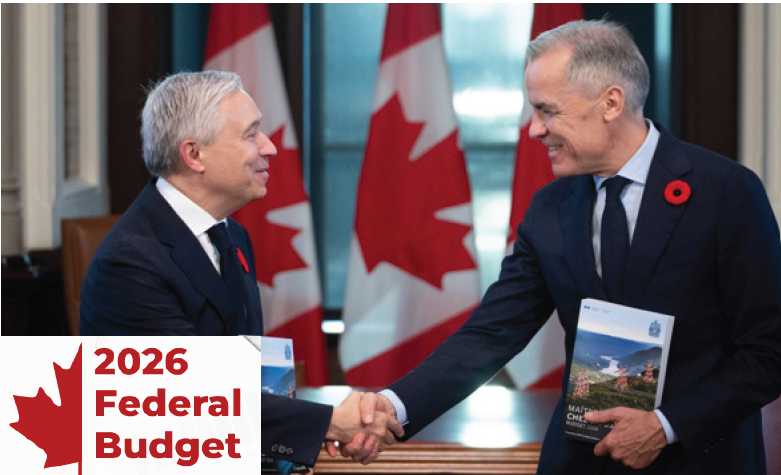
Canadian Â鶹´«Ã½Ó³» stakeholders offered resounding endorsement of Thursday’s federal Budget 2026, suggesting that under Prime Minister Mark Carney, there’s a coherent strategic framework for infrastructure investment not seen in recent times.
“There’s a whole huge recognition that Â鶹´«Ã½Ó³»’s infrastructure is an ecosystem that supports our economy, it supports our prosperity, it strengthens our sovereignty, and they absolutely get that,â€� said John Gamble, president and CEO of the Association of Consulting Engineering Companies – Â鶹´«Ã½Ó³».
“Laying down the groundwork to make Â鶹´«Ã½Ó³» more attractive for infrastructure investment… I think we have a prime minister, and by extension a finance minister, that fully understand the importance of infrastructure to our prosperity and our sovereignty.â€�
Finance Minister Francois-Philippe Champagne pledged $400 billion in capital spending over six years in Budget 2026 and formalized a new strategy, Â鶹´«Ã½Ó³»â€™s Investment Supercycle, through which the federal government hopes to catalyze $500 billion in new private-sector investment.
“Viewed through the right lens, there’s a line of sight on what the government is looking to achieve in terms of how it’s going to build a stronger economy and build growth into the Canadian economy,â€� commented Ken Lancastle, COO of the Mechanical Contractors Association of Â鶹´«Ã½Ó³».
Matti Siemiatycki, director of the Infrastructure Institute at the University of Toronto’s School of Cities, added, “Instead of just writing cheques and hoping the treasury can weather the storm, the government’s proactively trying to create wealth.â€�
New and expanded capital programs include a boost to the Â鶹´«Ã½Ó³» Strong Fund, renewal of the Zero-Emission Vehicle Infrastructure Program, significant new spending for Build Â鶹´«Ã½Ó³» Homes, introduction of the Â鶹´«Ã½Ó³» Growth Incentive and fleshing out the Productivity Mega Deduction.
Other highlights included support for an Early and Growth Stage Investment Strategy, a boost to Scientific Research and Experimental Development, further details on privatization of airport concessions, development of the National Electricity Strategy including the Smart Renewables and Electrification Pathways Program, billions for nuclear, critical minerals, high speed rail and First Nations infrastructure development, $4 billion to support a new Forestry Sector Accelerator and $3.1 billion for the Mackenzie Valley Highway.
Strong commitment to Â鶹´«Ã½Ó³»
“There’s a lot of good things for us in there,â€� said Rodrigue Gilbert, president of the Canadian Construction Association. “I think they’re realizing they need us to move forward. So we’re happy with the budget overall.â€�
“With $400 billion in investments in infrastructure over the next six years, including electrification, defence spending, other housing, this is really good for the Â鶹´«Ã½Ó³» industry,â€� said Sean Strickland, executive director of Â鶹´«Ã½Ó³»’s Building Trades Unions.
Strickland also noted the budget further codified funding for workers dislocated due to tariffs, and extended the Labour Mobility Deduction for Tradespeople, making it easier to obtain, he explained.
Gamble highlighted one “blind spot� – the absence of policy to support the STEM professions including engineers, architects, land surveyors and quantity surveyors through immigration or domestic development.
“I will call that a work in progress,� he said.
Gilbert identified another gap – the government’s failure to recognize the needs of non-unionized Â鶹´«Ã½Ó³» labour.
“The workforce in Â鶹´«Ã½Ó³» Â鶹´«Ã½Ó³» right now, it’s only 30 per cent unionized. The rest is open shop. I think there’s work to be done on that front,â€� he said.
“We’re going to keep working with them on that.â€�
Champagne announced new supports for apprentices including a lump sum as a hiring incentive and a weekly training supplement, but Siemiatycki suggested the workforce file will remain a challenge.
“To get people into those jobs and trained and have the skill to do it has not been easy,â€� he said. “The provinces have had programs, the federal government has had programs, but it’s been hard to get those to scale so far.â€�
Lancastle said his association has been leading the charge to convince the government to introduce tax relief for project financing and so MCAC was gratified to hear of the launch of the Productivity Mega Deduction in September.
“We were thrilled to see that announcement at the investment summit, and we were thrilled once again to see it as a cornerstone of this budget,� he said.
CHBA critique
Other stakeholders also issued statements on Budget 2026:
- The Progressive Contractors Association of Â鶹´«Ã½Ó³» said the plan represented “a strong step toward a more competitive, investment-ready Â鶹´«Ã½Ó³». The budget’s emphasis on competition, natural resource development, major projects, the skilled trades and smarter regulation sends a clear signal that Â鶹´«Ã½Ó³» is serious about getting major projects built.â€�
- From LIUNA: “Â鶹´«Ã½Ó³» needs an all-of-the-above energy approach backed by focused, coordinated action. Governments must work together to move projects from approval to Â鶹´«Ã½Ó³», reduce duplicative reviews and provide the certainty investors and communities need.â€�
- From the Canadian Home Builders’ Association: “(The CHBA) is encouraged that the federal government is recognizing the importance of supporting the full housing continuum,â€� stated CHBA interim CEO Frank Lohmann. “But we cannot lose sight of the importance of home ownership in Â鶹´«Ã½Ó³»â€™s housing system. We need more policies that support the Â鶹´«Ã½Ó³» of homes Canadians can aspire to own.â€�
- From the Insulating Concrete Forms Manufacturers Association: “Budget 2026 adds $13 billion over 10 years to Build Â鶹´«Ã½Ó³» Homes, bringing its total capitalization to $45 billion with a target of 200,000 homes over the decade…ICF is built for this kind of work.â€�








Recent Comments
comments for this post are closed