


The Winnipeg Construction Association (WCA) and the Construction Association of Rural Manitoba (CARM) are calling Manitoba’s restrictive apprentice to journeyman ratio of 1:1 a missed opportunity as the federal government is pouring billions of dollars into a major program to draw more young people into Â鶹´«Ã½Ó³».
“What it means is that less young people are entering the Â鶹´«Ã½Ó³» industry and pursuing a career in skilled trades,â€� said Darryl Harrison, WCA’s president and CEO.
The WCA and the CARM see employers and apprentices losing out on the $16,000 in income support during in-class training, the $5,000 Red Seal completion bonus and the $10,000 per apprentice first year wage subsidies. The two associations estimate, based on the declining numbers, that workers and employers can miss out on $50 million in federal support over the five-year life of the program.
“They (the NDP) argue it is a safety issue,� said Harrison, who for many years was a member of the provincial apprenticeship board.
The Manitoba Apprenticeship Board underwent changes when the NDP came into power in 2023. It removed several board members (including Harrison) and appointed five new members, four from organizations that were critical of the previous ratio of two apprentices to one journeyman.
“But that argument does not stand up to scrutiny and there is no research that, that ratio, is safer and, more importantly, that higher ratios than one-to-one does increase the safety risk and two or even three apprentices to a journeyman is less safe,� said Harrison.
His association has talked to the current government “many, many timesâ€� regarding the ratio, but the association’s concerns are not being heard, he said.
A 2013 CD Howe Institute commentary, Access Denied: The Effect of Apprenticeship Restrictions in Skilled Trades, warns of less youth entering trades, increased labour costs and difficulties for small companies to grow.
Safety is better achieved by onsite monitoring.
“In other words, instead of regulating inputs governments should shift the focus of trades’ regulation to outputs,� said the study.
Manitoba is not the first province where industry wants to open more doors for young people. In 2023, Nova Scotia, facing a Â鶹´«Ã½Ó³» skills shortage, announced an immediate change from the one journeyman and two apprentice ratio to three apprentices.
The Manitoba situation raises the question for the Â鶹´«Ã½Ó³» industry – what is the best practices ratio for the various compulsory skills in Â鶹´«Ã½Ó³»? It is a research question Â鶹´«Ã½Ó³» has done little to answer in the face of a looming skills shortage.
Workers Compensation Boards contacted from B.C. to Ontario said they have no comparative statistics (that can be tied to ratios) for apprenticeship injuries and fatalities and non-apprentice rates. Only Alberta has kept statistics on apprentice claims for injuries on the jobsite, and those figures over a 10-year period show a slight decline.
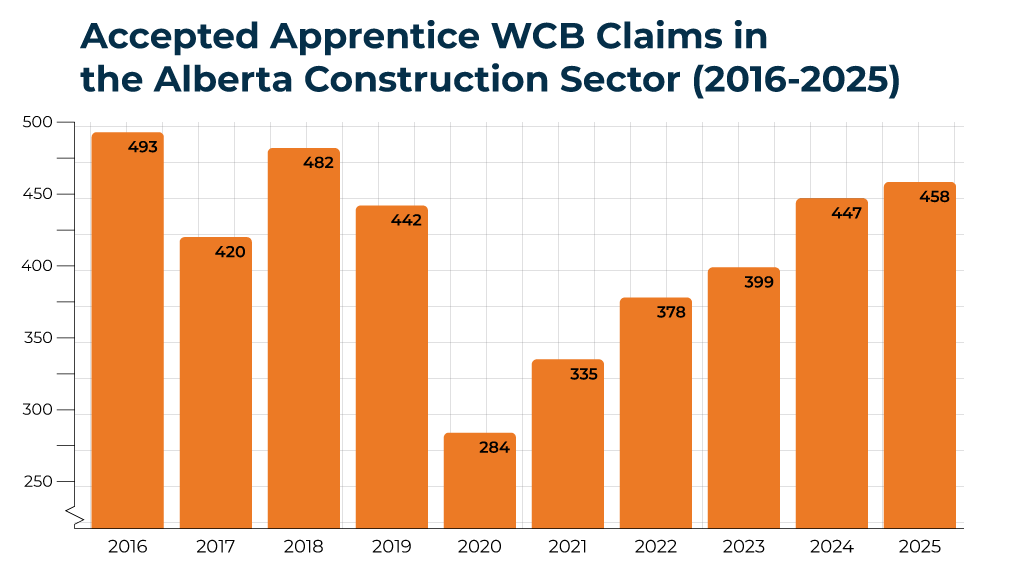
However, a US Journal of Safety Research (December 2022) finding indicates apprentices are safer inside a mentorship program.
“Our findings suggest that plumbers who complete apprenticeships experience fewer work injuries throughout their career compared with plumbers with no apprenticeship participation. Moreover, apprenticeships appear to play a key role in reducing work injuries, especially acute injuries,� the authors found.
Canadian provinces are divided on ratios. Western and Eastern Â鶹´«Ã½Ó³» have higher ratios than Central Â鶹´«Ã½Ó³».
B.C., Alberta and Saskatchewan opt for two apprentices to one journeyman.
Manitoba and Ontario use a one-to-one ratio, while Quebec uses a ratio of one apprentice to one or two journeyman.
Newfoundland and Labrador opt for two apprentices to one journeyman; New Brunswick, one apprentice per journeyman; Nova Scotia one journeyman to three apprentices; and Prince Edward Island, one journeyman to three apprentices – although some trades revert to a one-to-one basis. The ratios in most provinces exclude apprentices in their final year and also can be altered by union agreements.
An increase in the ratio for Manitoba would bring in more apprentices to fill a growing need in skilled trades.
“It would double the numbers,� said Harrison and help offset declining numbers in the province.
Since the NDP government reversed the ratio from two apprentices to one apprentice per journeyman, the WCA has reported new apprentice registration fell from 3,128 in 2023-24 to 2,730 in 2024-25, a drop of 398.
As well, the province saw active apprentices decline.
Manitoba saw 11,878 apprentices in the system last year compared to 11,628 this year, a drop of 250 from the training system.
The catalyst for Manitoba restrictive ratio was the 1999 electrocution death of unsupervised 19-year-old Michael Skanderberg, although he was not enrolled in any apprenticeship program, Harrison said.
Restrictive ratios also can see individuals working outside an apprenticeship arrangement.
Unions have spoken out regarding using unregistered individuals to do work in compulsory trades.
In 2018, the IBEW was critical of companies using or delaying registering apprentices to keep wages low. “It’s a huge problem,� said James Barry, IBEW Construction Council of Ontario.
At that time, he estimated there were 1,000 unregistered individuals in the industry at any one time.
Most provincial authorities have programs that protect new workers and are reviewed.
WorkSafe Saskatchewan said it is now working with safety associations on a new program aimed at mitigating workplace injury for new employees during the first seven days, seven weeks and seven months.






Recent Comments
comments for this post are closed